Sunday, April 17, 2011

Sweet H2O 50K 4/16/11 (Race Report)

On April 16, 2011, I completed Sweet H2O 50K with a finish time of 8:43:51 and took over an hour off my time from the previous year.

Photo courtesy of Johnny Buice
Most of my earlier ultramarathon race reports have featured dramatic story arcs where I suffered from extreme mental and physical low points, but was able rely on relentless forward motion to push through the hardship and finally cross the finish line with a smile on my face.  This year's Sweet H2O 50K was a different experience for me, because I did not have any low moments during the event.  For the entire 32.6 miles of this course, I enjoyed the company of friends, I moved forward with a deliberate pace of walking the hills while running the downhills and flat stretches, I timed my hydration and food intake consistently, and I benefited from perfect race weather where the temperatures were ten degrees cooler than the previous year.  With my final placement at 193 out of 209 finishers, I will not be confused with an elite ultrarunner, but I still feel that everything came together for me this time around.  This outcome may result in a boring race report, but it was a positive experience on my road to becoming a better runner.

The Sweet H2O 50K takes place at Sweetwater Creek State Park in Lithia Springs, Georgia and is an annual event put together by Race Director Johnny Buice and the Douglas County Rogue Runners.  The race course combines technical single-track trails, pavement, water crossings, dirt road sections, and multiple daunting hills for an experience that provides a war of attrition against runners as cool morning hours under waterside leaf cover give way to the open terrain of continuous hills under the afternoon sun.  Just before reaching the pinnacle of the course, a hilltop section called the Top Of The World, runners ascend a brutal ravine climb only to be rewarded by the view of multiple steep hills and descents ahead, and the realization that this is only the first of two loops along this route threatens to collapse any confidence that the runners had going into this race.

Photo courtesy of  Robert Lewellen
The understanding that this race is at the mercy of Mother Nature became all too apparent in the hours just before the start, when severe thunderstorms caused the creek waters to rise to threatening levels and race officials realized that the trademark creek crossing section of Sweet H20 50K, where runners use a rope to make their way through waist-deep waters to a two-mile trail loop and then cross once again by rope to the main trail route, would have to be eliminated from the course this year.  Thanks to some quick thinking by the race officials, the course was altered to replace the creek crossing trail loop with an additional pavement stretch where the initial section of the race was repeated to replace the mileage. Runners would still cross the spillway twice on the new course and, since a few sections of the trail beside the creek were submerged as waters rose, the legendary difficulty of Sweet H20 50K was not diminished.  With a final distance of almost 33 miles, we still benefited from free mileage for our money on the quickly-altered route.

Days before the race, several friends and I motivated one another with a series of trash talk emails where we each called out our goal finish times.  I enjoyed calling out arbitrary goals, but I remembered my struggles at the 2010 race all too well.  Last year, I was heavier in weight and suffering the residual fatigue from a marathon two weeks prior, so I crumbled under the 80-degree afternoon sun and walked the entire 17-mile final loop to finish second-to-last in the race.  My only real goal for this 2011 race was to enjoy the day and have the ability to run at a decent pace in the final miles, instead of merely surviving the event as I had last year.  I was not in ideal condition this year either, since my recent weight loss had stalled after regaining some pounds over Christmas, but I knew that I had become a more efficient runner and that I could improve well over my previous finish time by making intelligent pace decisions and not losing the plot.

Photo courtesy of Naresh Kumar
For this race, I would be using a Camelbak Rogue 70-ounce hydration pack instead of the two handheld water bottles that I had carried the previous year.  I stashed several gels into the Camelbak compartments with the intention of eating these gels throughout the race instead of eating cookies and candy at each aid station.

My choice of trail shoe for this race proved to be a wise decision.  For my past trail ultramarathons, I had worn the Montrail Hardrocks, because these heavier shoes catered to overpronating runners like me who need added stability.  After I used up my last pair of Hardrocks, I wore the Hardrock replacement line, the Montrail Badrocks, to Mount Cheaha 50K in February. While the Montrail Badrocks felt great on non-technical trail surfaces, I found that they were not handling as well on rocky technical terrain.  I have owned a pair of Montrail Mountain Masochist shoes for almost a year now and have found them to have a better fit than any other trail shoe that I have tried, but I have been hesitant to attempt wearing them for long distance runs due to the relatively low profile heel.  For Sweet H2O 50K, however, I gave in to my curiosity and wore the Mountain Masochist shoes.  I am pleased to report that the Montrail Mountain Masochists gave a stellar performance during this 50K.  I had a better feel for every type of terrain along the trail and the shoes drained so well that my feet felt completely dry mere seconds after each water crossing.

When I arrived at the race start, I was relieved to find out that the thunderstorms that had wreaked havoc on the area overnight had moved on and that sunny skies were soon on the way.  After a brief announcement from the race director about the course alterations, we started along the paved road that would thin the runners along the first mile and half before we entered the single-track trails.  I was happy to be joined by a friend from South Carolina, Jason Sullivan, with whom I would run the entire race.  I enjoyed the opportunity to run with Jason, because of his wealth of knowledge from the 33 ultramarathons that he had completed to date. Like me, Jason is a “husky size” ultrarunner and, as such, has to overcome similar physical and psychological challenges on these long runs where fuel and hydration balances are so crucial.  Jason is a strong runner who has completed a 100-mile race, but he is also able to maintain a great sense of humor. Jason and I were joined occasionally by other runners along the course and the constant company kept all of us from giving way to the self-doubt that can follow runners in solitude.
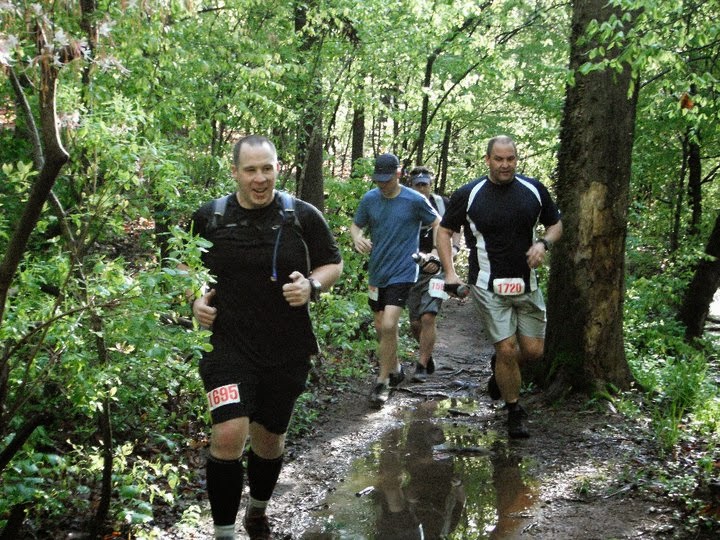
Photo courtesy of Samuel Louie
When we left the pavement for the trails, we encountered a few muddy sections, but we were mostly thankful that the sandy soil of the area helped drain the trails.  After a short distance on the single-track, we emerged to the first spillway crossing.  The concrete banks were still slick from the storm rains, so I used a rope to climb down to the bottom, where cold water rose above my ankles.  I became the comic relief of this ultramarathon on the other side of the spillway when I attempted to climb the concrete bank without a rope and quickly slid back down to the water.  Laughing at my mistake, I quickly rejoined the others in line for the ropes to climb out of the bank.

After Jason and I climbed out of the spillway and resumed our run on the trails, we encountered a few wide puddles of water that we simply splashed through. My feet had already been submerged in water once, so it was best to embrace the discomfort and not go out of my way to avoid water on the trail.  We soon arrived at my least favorite part of Sweet H2O 50K, a descent down a steep rock-covered hill where the wet and muddy rocks shifted under each step.  I tried not to visualize myself slipping and falling face-first onto the sharp-edged rocks as I grabbed the occasional tree for balance.  A few similar challenges awaited soon after, as we climbed down steep muddy hills that required careful attention.  I was thankful for a large tree that stood in front of the creek at the bottom of one particular muddy hill, because I was able to slip downhill into the tree instead of continuing to slide into the creek itself.  As we passed the site of the eliminated river crossing section, Jason and I watched the rising flood rapids sweep just below the crossing rope and immediately decided that we were thankful that the race course had been altered.  We arrived at the first aid station to the cheers of Kirsten and other volunteers.  Despite the plethora of M&M's, potato chips and other temptations, I stayed true to my resolve and simply topped off the water in my Camelbak before continuing.

Now that we had finished the treacherous descents of mud and rocks, we were thankfully rewarded by a few miles of relatively easy trails along the side of Sweetwater Creek.  I quickly settled into an easy pace of walking the small hills and running the rest of the trail as I talked with Jason and another runner, David, who had joined us.  Since Jason and I were both veterans of this particular race, we knew that it was best to run comfortably on the trails that led to the Top Of The World hills that would soon greet us.  The occasional makeshift bridges of single wooden boards over small water crossings provided endless amusement for us and we kept joking about hearing these boards crack under our heavy weight.  As we left the waterside trail and continued along a scenic rolling hill trail, I settled into my routine of eating a gel every half hour and taking one S-Cap every hour for adequate sodium.

The second aid station was a welcome addition to the 2011 course, since I was now able to fill my Camelbak with water before tackling the Top Of The World hills. The trail leading out of the aid station, with its straw-covered path in high grass alongside the bottom of a huge rock wall, made me think of scenes from Akira Kurosawa samurai movies.  After a short climb out of the grass ravine, Jason, David, and I enjoyed an extended flat section of trail through a meadow that led to the first series of hills that marked the beginning of the Top Of The World stretch.  All three of us were gung-ho about the harsh terrain to come and that excitement quickly carried us up the gravel road hill that led away from grassy flatlands.

Wet rocks and mud provided a small challenge on a steep descent to a cold stream crossing that gave my feet a welcome ice bath of sorts before climbing the amazingly steep ravine trail.  We reached the top of the leaf-covered ravine trail and quickly made our way on the first downhill in the Top Of The World series so that the sight of neverending hills over the horizon would not intimidate us.  When I occasionally reported the distance and countdown time from my Garmin watch to Jason, he was enthusiastic that we were making great time with our constant pace.  We both primarily wanted to finish the race strongly, but we could not resist projecting possible finish time of eight hours, eight-and-half hours, and so on.  We finally agreed that a sub-nine-hour finish would be great on this day. Jason, who was returning from a brief hiatus from ultramarathons, was overjoyed to be running an ultra again and his excitement was contagious.  Jason, David, and I were soon joined by Lynne, a fellow ultrarunner whom I had met at Mystery Mountain Marathon a couple of years ago.

Impossibly steep hill climbs followed impossibly steep hill climbs until we finally reached the entrance to Top Of The World.  A friend of ours, Wayne, who was way ahead in the race, jokingly taunted Jason and me when he saw us starting the entrance trail just as he was leaving, and we spent the next several minutes talking about how we wanted to chase Wayne down and pass him on the second loop.  The actual Top Of The World hill, from which the Atlanta skyline can be seen, marks the entrance to an out-and-back trail to the third aid station, so I enjoyed seeing several faster friends running in the opposite direction on their way out of that aid station.  When we arrived at the aid station, I was happy to see my friend, Scott, with whom I had run several races, volunteering at the tent.  I did not have much time to catch up, though, because I wanted to avoid resting at the aid stations for too long and the others with me shared the same resolve.  Jason, Lynne, and I ran together on the way out of the aid station as David moved ahead.

The repeat elevations were not over yet and the three of us made our way back to Sweetwater Creek via the power line trails, where we alternately ran down treacherously steep dirt hills and quickly hiked to the top of each subsequent hill crest.  We were relieved to return to the flat trails beside the creek so that we could resume a consistent running pace as we got closer to Jack's Hill, the final infamous climb of the first loop. Jack's Hill is a runnable trail under most circumstances, but the three of us were happy to power-hike the incline to the next aid station, where a fellow ultrarunner and friend, Cindy, volunteered and greeted us with smiles.  I decided that it would be in my best interest to take one of the peanut butter and jelly sandwich sections for additional energy, but I still maintained my resolve to avoid the cookies and candy at the aid station.  We continued along pleasant rolling hill gravel roads that passed a somewhat unsettling park sign notifying us that we were in a timber rattlesnake habitat. The most pleasant section of Sweet H2O 50K, a mile of winding trail covered with plush pine straw, allowed us the opportunity for a nonstop run to make up time.  After rounding out an extended curve to a paved road, we passed the finish line group shelter and completed our first loop in just over four hours.

Photo courtesy of Susan Donnelly
As we ran a relaxed pace along the paved park entrance road on the second loop, our spirits were given an additional boost when a car pulled next to us with my friend, Sean, a fast runner who had just completed an inspirational running adventure in the Himalayas, riding as passenger.  Sean cheered us on and we talked to him for several minutes as the three of us ran alongside the car.  Jason, Lynne, and I turned on to the main road and avoided traffic hazards by running a makeshift trail on the other side of the guard rail as we complimented one another on making good time.  This paved section on the second loop had killed my spirits the previous year, so I was feeling pretty good to have some running energy left.  We rounded the single-track trails and crossed the spillway once again, surprised to find that the water had actually risen to a higher level around our shins as we walked quickly across to rope-climb the embankment on the other side.

Lynne raced ahead, as Jason and I had long suspected that she would, and the two of us continued along the series of dangerous rock and mud descents, relieved that the mud had noticeably dried in the afternoon sun. The subject of conversation repeatedly turned to whether or not we had it in us to finish with a strong sub-nine-hour finish and we agreed that we both had enough energy to knock the second loop out in less than five hours.  My Montrail Mountain Masochist shoes still felt good and I was confident that they would keep me in good form for the duration, although they were more minimalist in the soles than I was accustomed to from my previous bulky shoes.

During this portion of the second loop at the 2010 race, I had been drained of energy and had only been able to walk at a steady pace, so I took comfort in the ability to run long stretches on the waterside trails.  The water level had risen higher throughout the day at Sweetwater Creek and we were trudging through water more often during the second loop, but I was enjoying the feel of the cold water on my feet.  Whenever Jason and I reached a non-technical stretch, I told him that I wanted to run while I could, but that I would not be able to keep running for long.  After a few miles, Jason joked, “You keep saying that you're going to stop and walk, but you just keep running.”  We were both feeling pretty good, though, and we both seemed to know exactly the right moments to start walk breaks.  In the days leading up to this race, I had been listening to a rock song, “Recharge and Revolt”, by The Raveonettes, and I told Jason that each walk break was a chance to “recharge and revolt” before the next long running stretch.

Jason and I started to pass a handful of other runners on the trail and each encounter gave us new momentum.  Jason had accurately predicted that we were going to start passing people on the second loop if we maintained the steady pace and those predictions were coming true.  We reached the second aid station where Jenn, a friend who had just returned from an impressive Umstead ultramarathon run and who had seen me at my worst physical moments at the previous year's Twisted Ankle Trail Marathon, briefly quizzed me on how I was doing and whether or not I was taking in the right amount of fuel and water.   I gave her the thumbs-up that everything was going well.  Another runner, Dean, whom I recognized from previous races, decided to run along with Jason and me as we left the aid station and made our way to the long open meadow section, which I named “the run in the sun”.  I told Dean and Jason about my misadventures along this section during the previous year, when I was walking miserably under the brutal sun out in the open and watching one of my ultrarunning friends, Graham, move farther and farther away in the distance.  There was no walking along this portion of the trail in 2011, though, and the three of us traded jokes as we got closer to the Top Of The World.  I was in a hurry to get this flat meadow section completed so that I could, in turn, get the Top Of The World out of the way. We soon passed a female runner who decided to keep up with us. Rose would accompany the three of us for the next several miles. As I had promised Jason and Dean while we were running through the open meadow trail nonstop, we enjoyed a long walk break when we reached the gravel road leading up to the first series of hills. We resumed an easy run as we descended the rocky section leading to the last big stream crossing.  I avoided the temptation to lie completely down in the stream for a cold ice bath effect as the four of us arrived at the ravine trail climb.

The ravine trail on the second loop was the point in the 2010 race where I had resolved not only to drop out of the race, but to drop out of running altogether.  This distant memory was made all the more distant as I climbed the ravine trail with a smile on my face while Dean constantly joked around with everyone.  Dean's presence on this entire section was a blessing, because he kept all four of us in good humor during the toughest part of the race.  I took the lead on the series of hills leading to Top Of The World and remained about 20 feet ahead of Rose, Dean, and Jason.  I wanted to stick with the crowd, but I was also in a hurry to get this section out of the way as soon as possible.  I could hear Dean and company behind me and I turned around occasionally to joke with them.

This Top Of The World series of hills was harsh and unrelenting, but so were the four of us.  This report probably makes Sweet H2O 50K seem easier than normal, because I really cannot recall any specific moment from the race when I felt down on myself or when I was unable to remain in good spirits.  Every part of my body was hurting along these Top Of The World hills, but the camaraderie that I enjoyed with friends old and new made everything bearable and even fun.  During this race, I learned the most valuable lesson of my ultrarunning life so far. I learned that the ability to remain optimistic and to find humor in every situation is the most important ultrarunning tool and that this ability can overpower physical discomfort.  I was getting hot under the sun, my legs were hurting, and I was definitely winding down, but I was also enjoying a fun Saturday afternoon with friends.  In the same way that Charles Halloway shows his son how to defeat the demons and darkness with laughter in Ray Bradbury's novel, Something Wicked This Way Comes, I was reminded that happiness and positive thinking could defeat fatigue during one of the most difficult 50K races of all.

When we reached the Top Of The World summit, I resumed running alongside the other three and we congratulated the other runners that we saw leaving the out-and-back aid station in the opposite direction.  Scott cheered us into the aid station and I enjoyed two huge cups of Gatorade while a volunteer refilled my Camelbak.  Scott offered the last two slices of pizza to us and I politely declined while Jason took a slice.  I was overjoyed when one volunteer congratulated me on how I looked a lot slimmer compared to when she had seen me while volunteering at the same aid station the previous year.  Just as Rose, Dean, Jason, and I were getting ready to leave, we saw two more of my ultrarunning friends and personal heroes, Susan and Rob, running in from the trail. I joked with Jason that I had known that Susan and Rob would catch us at some point.  Rose ran ahead while Susan took pictures of Rob, Jason, and I. Dean caught up to us soon after and the five of us commented on the view of Atlanta as we completed our final Top Of The World trek of the race.

Photo courtesy of GUTS
Susan and Rob stayed behind at the entrance to talk with Sarah, who was volunteering at the intersection, so Dean, Jason, and I kept running to begin the power line trail section.  Dean began joking with Jason and me that he could run the hills in a hurry and we encouraged him along.  When Dean did, indeed, speed ahead of us to run up the hills effortlessly, Jason and I laughed and decided that Dean had been sandbagging all along earlier in the race.  Cramps started to erupt up and down my legs during one steep power line climb, so I took my final S-Cap of the race and made sure to bite down on the capsule so that the electrolytes could start working as soon as possible.  Nothing was going to deter me from a sub-nine-hour time this year.  Jason was clearly more energetic and he told me that he felt like he could run a 100-miler.  When I expressed admiration at his resilience, Jason told me that the pizza slice at the last aid station had given him a real second wind.  I learned yet another valuable lesson. I should not turn down pizza when it is offered to me at an aid station. 

Despite my unfortunate dismissal of a pizza offer, I was pleased with my fuel and electrolyte strategy for this race.  For most of the day, I avoided taking food from the aid stations to rely instead on the gels that I had brought to the race.  Each half hour, I alternated the Crank e-Gels with Accel Gels, which contain protein, and these electrolyte sources kept me on the move when combined with an S-Cap once an hour.  I did take a couple of small peanut butter and jelly sandwich quarters from the aid stations and, at one point after the final Top Of The World pass, I ate a few Gummi Bears.  I also did not hesitate to drink cups of Gatorade or soda at the aid stations.  For the most part, though, I refrained from my usual strategy of leaving each aid station with handfuls of sugary foods.  For this reason, I think that I was better able to judge the level of sodium that I was putting into my body during the race and this enabled me to balance the hydration intake accordingly.  My Camelbak does not have a flow meter for the water, but I am certain that I adhered to my strategy not to drink more than 30 ounces of water per hour.  When I arrived at the finish line, I was not bloated from sodium or hydration excess like I have been in the past. 

Jason and I made our way up Jack's Hill in good spirits as we saw the watch countdown in our favor for a sub-nine-hour finish and, possibly, an 8:30 finish.  Cindy enthusiastically cheered the two of us along as we arrived at the final aid station and told us that we had 2.25 miles left to go.  Jason and I left the aid station debating the mileage, because we were both certain that we were closer to the finish than that.  As it turned out, Cindy was right, because the shorter route to the finish had been removed to make up mileage after the elimination of the stream crossings.

We ran at a decent clip for the gravel road section and power-walked the two notable uphills.  When we finally reached the glorious pine-straw trail on the final stretch, we began the nonstop run on the last mile and half to the finish.  I encouraged Jason to pass me if he wanted to, because I could see that he had a lot more energy in the bank, but he assured me that he wanted us to finish together.  We both picked up our pace noticeably when we smelled the barbecue chicken at the finish area.  I was grateful for the company and conversation along this final stretch.  When we reached a small hill a half mile from the finish, Jason asked me if I wanted to take one last walk break and finish strong, but I replied that I felt good and that we should keep running.  We exited the trail to a hilly pavement stretch to the finish and picked up our pace, both of us laughing when I commented about how the road was never going to end.  We made the last turn up some wooden steps and crossed the finish line while friends from GUTS (Georgia Ultrarunning and Trailrunning Society) greeted us with cheers.  We both crossed the finish line as the clock read 8:43 and shook Race Director Johnny Buice's hand as he congratulated us on another successful race.

My official finish time was 8:43:51 and I had placed 193 out of 209.  Jason and I had made good on our determination to finish Sweet H2O 50K in under nine hours and I had beaten my previous year's time by over an hour.  I credit the lower temperatures in 2011 with my faster time, but I will gladly file this as a course record just the same.

I spent a long time at the finish area with friends and food.  The barbecue chicken hit the spot, the chairs were comfortable, and, as with all post-ultramarathon celebrations, the stories were fun to hear and to tell.

The first, and hopefully not the last, ultramarathon with no crushing mental low points was in the books for me. I feel like I left everything on the course in physical terms, but I also felt good as I walked around slowly after the race.  My mental state had remained upbeat and my body had rewarded me in turn.  At one point during the race, Jason and I had reminded ourselves that we do not get paid to run ultramarathons, so the primary goal is to stay safe and to have fun.  I am proud of my faster time, but I am prouder of achieving that primary goal.

Thanks to Johnny Buice and the Douglas Country Rogue Runners for making Sweet H2O 50K possible for another amazing year.  Thanks to my GUTS friends for the encouragement and for hanging around at the finish. A hearty fist pump goes to Jason Sullivan for running the entire duration of the race with me and for the fun conversations.  Congratulations to everyone who ran well at one of the toughest and most rugged 50K plus extra mile courses around.

See you on the trails.

Jason


Wednesday, March 23, 2011

Publix Georgia Marathon 3/20/11 (Race Report)

On March 20, 2011, I completed my tenth marathon, the Publix Georgia Marathon, with a finish time of 4:46:23.

Photo courtesy of Susan Hornbuckle
This event was the most fun pavement marathon race that I have run to date, despite a handful of challenging setbacks that could have derailed the experience.  On the morning of this race, I woke up with a sore throat that signaled the beginning of a head cold and my legs were in fatigued condition after a poorly-executed taper week, but I rubbed dirt on these stumbling blocks and readied myself for what has become one of my favorite local events.  The Publix Georgia Marathon, formerly the ING Georgia Marathon, would carry me through 26.2 miles of hilly Atlanta roads and familiar city landmarks where I would encounter friends, old and new, by way of fellow runners and volunteers.  This marathon takes place at the beginning of spring and the chilly starting line temperatures always seem like the last dying gasp of winter as they are swept away from the city streets by a mild heat while runners make their way to the finish.  I knew that I was not at my best when I lined up in my starting corral, but I was not going to let a head cold or a poor taper week prevent me from watching months of early winter morning training runs under bundled clothes fall behind in the rear view mirror as I crossed the finish line of this event with a smile on my face.

Ambitious goals do sometimes have to be shelved under certain conditions, though.  After I spent the weekend before this marathon achieving a new personal record at a local 10K race and then tiring my legs the next day with a spontaneous decision to run ten fast miles around my neighborhood in sunny weather, I realized that my chances of beating my previous marathon record of 4:20:10 from the 2009 Chickamauga Battlefield Marathon were slim at best.  When I volunteered at the Publix Georgia Marathon Race Expo and spent eight hours moving heavy boxes on the Thursday before this event, I woke up tired the next day and decided that I should modify my goal and simply strive to beat my 4:58:48 finish time from last year’s Georgia Marathon.  Finally, after I had trouble falling asleep on the night before the race and woke up from only two hours of sleep with the sore throat, I shrugged and decided that my final goal for the 2011 Publix Georgia Marathon would just be to have as much fun as I could and to keep from embarrassing myself too badly.

I arrived at Centennial Olympic Park in Atlanta a couple of hours before the race start, secured a spot in my favorite parking lot next to the finish area, waited for friends at the Galloway Marathon tent, and made a couple of last-minute decisions that would ultimately help me enjoy a better race.  Since I was convinced that I had cost myself a sub-50-minute time at my 10K the previous weekend by obsessing over the pace numbers on the main display of my Garmin watch, I decided to remove the pace from the main screen display altogether and replace it with the Galloway interval countdown.  I also took a second look at the high number of water and Gatorade stops on the marathon course map and decided that I would not need to carry my handheld water bottle.  I removed my truck key from the water bottle pouch, tied the key into the laces of one of my New Balance 850 shoes, and left the handheld bottle at the tent for safekeeping.

I lined up in the starting corral with Scott, a friend with whom I had run a few recent ultramarathons, with the intention of running with him for company while we could maintain identical paces.  I knew from past experience that Scott’s sense of humor would make for some interesting early morning miles.  I am ashamed to say that, after over a year of avoiding diet sodas, I had recently fallen off the wagon and had, in fact, enjoyed a few too many Diet Mountain Dew bottles as I rested the day before the race.  The effects of the diet sodas were making themselves clear as I briefly left the start corral just minutes before the race to water some nearby bushes behind a concealed parking lot.  I would end up wasting several minutes of this marathon race with multiple bathroom stops and, when I returned home later, I would immediately resolve to resume drinking water through my normal training days.

Scott was listening to his iPod in one ear as we began moving toward the start line with our corral group and we had fun comparing favorite running songs.  I started my Garmin watch countdown as we crossed the start line and settled into a comfortably slow jog in the middle of the crowd.  As we ran with an easy conversational pace through the streets surrounding Georgia State University, Scott and I exchanged jokes as the occasional runner threw us a bewildered look.  We also reminded each other that, since the marathon runners were vastly outnumbered by the half marathon runners at this event, we needed to stick to our own comfortable early pace before the two races split after the sixth mile and not worry about how many others were passing us.  My experiences on this course during the previous year’s race had taught me that the hills of the final miles were unforgiving to runners who paced themselves too quickly at the beginning.

Just before the first aid station, I ran down some stairs of a parking lot adjacent to Piedmont Road to make the next of many bathroom stops and then caught up with Scott before grabbing a half cup of Gatorade.  Scott and I resumed running together as we ran down a North Avenue hill and turned onto Central Park Place to run under blooming trees. Scott expressed concern for our pace as we crossed the third mile marker at 34 minutes, but I was content to allow for at least two hours and 20 minutes for the first half of this marathon course and then let the race begin in the latter half.  I was feeling slightly under the weather and I would need to draw on the conserved energy later.  As with all my pavement marathon races, I was using Galloway 4-minute-run/1-minute-walk intervals and, during one of the walk breaks, I enjoyed a bridge crossing over Freedom Parkway that shows my favorite view of Atlanta just before passing the Martin Luther King, Jr. historic sites.

When Scott and I were halfway through the fourth mile of the course, I took advantage of one of my walk intervals to pull over into thick bushes for another bathroom stop.  Scott joked, “You need to decide whether you want to run a race or go to the bathroom.”  I replied, half-jokingly, “I was actually planning for a lot of bathroom breaks today with a little bit of running in between.”  The frequent bathroom breaks were an annoyance, but I decided just to roll with it, knowing the situation would improve as I continued running and consuming electrolytes.  I felt more confident with my pace when Scott pointed out that the runners around us were starting to slow down already.

When we entered the Little Five Points area, Scott and I resumed our music discussion as we ran by a couple of favorite independent record stores.  I knew, however, that Scott wanted to plow ahead without the Galloway intervals, so I told him not to feel badly about running ahead and that I would try to catch him during the second half of the race.  Scott sped up and kept running as I started my next walk interval.  I was hardly starved for company in the crowd, though.  When I saw a runner wearing the trademark Marathon Maniacs singlet, I introduced myself as Maniac # 1549 and enjoyed brief conversation as I continued though the split at mile 7 and soldiered along the full marathon course into the Candler Park neighborhoods.  I employed a slightly faster pace when the crowd thinned after the split and even managed to maintain momentum through a few “speed bumps” by way of the Candler Park hills.

I was happy to see a handful of friends from Get Fit Atlanta at the mile 10 aid station, although I wondered in a daze why one of them who greeted me by name was wearing some sort of film noir spy chemical mask outfit.  When my friend, John, asked me after the race if I had liked his Rorschach costume from Watchmen, I laughingly berated myself for being too focused on my race to recognize a character from a comic series that I had loved in my teenage years. 

The next three miles of the race were relatively uneventful for me as I kept a lid on my temptation to run faster during a few flat road sections that led into the city of Decatur.  I thanked volunteer police officers and amused myself by reading a series of rhyming signs placed beside the Decatur roads to motivate the runners.  I was looking forward to reaching the halfway point of the course and my patience was rewarded when I crossed the 13.1 timing marker and checked my stopwatch to see a time of 2:24:30.  During last year's race, I had arrived at this same checkpoint with a 2:15:00 time, but had hit a wall on the hills of the final miles.  This time, I was confident that my slower first half would allow me to maintain my constant Galloway interval pace without taking additional walk breaks on the hills.

The three-mile stretch from Decatur to Emory University consisted of a gradual downhill that I enjoyed with a faster, but still leisurely pace before the trial of hills began just after the mile 16 marker.  The sky was overcast, but the temperature was warming up noticeably on a humid day.  When I felt the first hints of a leg cramp, I took two S-Caps from the net pockets that lined the waist of my running shorts.  During this three-mile section, I enjoyed interacting with one runner whom I would pass during each of my run intervals only to be passed again during each of my walk breaks. Each time, we would wave and give amused well-wishes to each other.  In a marathon, some runners are like Soviet jets in the movie, Top Gun, and you cannot evade them.  This camaraderie continued for the next several miles until I eventually stopped seeing him again during my walk intervals.

After the mile 16 marker, I reached the never-ending Lullwater Road incline that served as the appetizer for the steady diet of climbs that would continue through the Druid Hills neighborhood.  The time for pleasantly holding back on my pace was over and I charged the hill, eager to have this section behind me.  When I crossed the mile 17 marker just before Ponce de Leon Avenue, I looked at my watch and realized that just over three hours had passed.  I reminded myself that I had a good chance of beating last year's time at this race if I did not lose the plot. Do not lose the plot, Jason.  Do not lose the plot.

I turned off Ponce de Leon onto Oakdale Road and continued the brutal punishment of climbs through the Druid Hills area, using mental tricks and old song lyrics to push myself with a deliberate running pace to each subsequent Galloway walk interval.  I appreciated the occasional encouragement that I received from Druid Hills residents that tailgated in their front lawns with friends to cheer all of us along the way.

As I lumbered up and down the hills of the mile 18 section, I received an unexpected wake-up call that would fuel the rest of my race. When I waved to a woman who standing on the side of the road to cheer for the runners, she told me that she was here because she had lost her daughter almost a year ago.  She pointed to a nearby sign for The Amanda Riley Foundation, an organization founded to help children and teens suffering from cancer.  I thanked the woman for being there and continued down the road, but I could not get the encounter out of my mind.  My struggles to finish a marathon were insignificant and trivial compared to the hardships that this woman had overcome during the past year and I was reminded once again that I was blessed simply to be able to participate in this event.  Although I am a state government employee who struggles to make ends meet from one month to the next, I made a silent promise to donate to The Amanda Riley Foundation when I returned home to my computer after the race.  Armed with a new sense of perspective, I ran with a stronger pace.  When I plugged my Garmin watch into my computer after the race and analyzed my mile splits, I was not surprised to find out that I had achieved one of my fastest mile paces along this section.

The hills did not relent, but neither did I.  I stayed true to my run intervals, even when those intervals started at the bottom of a steep climb.  Do not lose the plot, Jason. 

I was carried along the remainder of the race by seeing friends at just the right moments.  As I ran up a hill to make my way out of the Druid Hills neighborhoods for good, I passed Len, a friend from my local trail running group, and he sped up to run alongside me. Len and I soon reached Stillwood Drive, the nemesis of my race from last year.  Stillwood Drive has the steepest set of hills of the entire course and is indifferent to the exhausted runners of mile 20 who must ascend each incline only to dive down to the next.  Last year, this section had reduced me to a walk for the entire mile. I was not going to let this happen in 2011. I walked when my Galloway interval beeps called for it, but I ran every step of the way up these hills during my four-minute running bursts.  Before I knew it, Stillwood Drive was just a memory and I was still running.  I received more uplifting encouragement when Len and I ran the last hill to Virginia Highlands and were cheered along by Sarah, another trail running friend who was waiting to pace Kirsten, who was completing her first marathon.

With Len close behind me, I made my way into Piedmont Park, grateful to see Susan and some other friends from my Galloway group cheering just before the park entrance.  My resolve to stick to my running intervals through the steep hilly neighborhoods of Druid Hills and Virginia Highlands had left me exhausted and I must have been noticeably struggling as Len and I turned around the Piedmont Park lake, because Len encouraged me that I only had a few miles left.  I was occasionally feeling a rise in my body temperature and I knew that there would be a cost to running this race while I was under the weather from sore throat symptoms.

As Len and I started up a laborious hill at the beginning of an out-and-back around the park grounds, we were cheered along by another crowd of trail running friends, Kim, Desiree, John, and Kim's daughter.  When I made it to the top of the hill along the out-and-back, something inside me snapped and I found an unexpected second wind of energy.  The realization that I only had a few miles left to go hit me and I knew that I was capable of a strong finish.  A runner who was going the opposite way on the out-and-back must have recognized my distinctive look and my black outfit, because he asked me if I had run the Twisted Ankle Trail Marathon.  I nodded and waved at him as I passed, since I was desperate to keep the momentum.  Do not lose the plot.  Do not lose the plot.

Len and I hurried downhill from the out-and-back section, where I thanked Kim and the others profusely as I passed by.  Len and I were about to start the arduous 12th Street hill out of the park, but I decided to pull off into the park bushes for one last bathroom break.  I am looking forward to seeing the flowers and leaves bloom throughout Atlanta over the next couple of spring months, because I am pretty sure that I fertilized the entire city quite well during this race.

The 12th Street hill climb was alleviated by perfect timing, because one of my Galloway walk breaks fell squarely in the middle.  I waved to the volunteers who supplied me with water as I grabbed another Crank e-Gel from the net pockets of my shorts and ate it for some quick energy for the hills that would line the last three miles.  Spring Street is no picnic, as far as the hills are concerned, but I ran this mile at a decent pace as I leapfrogged Len and Caroline, a friend from the Marathon Maniacs group.

From Spring Street, I turned south over the bridge into the Georgia Tech campus and silently envied the carefree students who lounged around the lawns of their fraternity houses.  As an alumnus of Georgia Tech, I should remember that a Tech student's life is anything but carefree.  I envied these students nonetheless as I soldiered along a hill climb next to Bobby Dodd Stadium and my old dorm buildings.

My friend, Julian, with whom I had traveled to the Long Cane 55 Mile Ultra several months ago, was standing by the final aid station with encouragement after he had already completed his race.  I was grateful for the well-wishes as I ascended the final challenging hill to start a relatively flat final mile.

The last mile of the Publix Georgia Marathon is sadistic in its simplicity. Exhausted runners continue along a flat road where the Omni Hotel next to the finish can be seen the entire time, but never seems to get closer. After an eternity, the crowds along the side of the road thickened and the horse smelled the barn. I dispensed with my Galloway walk intervals during the last half mile and ran my way home.  I waved to a friend, Beth, who cheered from the side of the road as I made my final turn and ran a hundred yards through the finish line.

I finished the Publix Georgia Marathon in 4:46:23.  I had beat my time from the previous year on this same course by 12 minutes.

A volunteer hung a finisher's medal around my neck and I made my way to a group of friends just beyond the finish crowd.  Scott soon found me in the crowd and we greeted several other friends as we made our way back to the Galloway tent where I retrieved my water bottle.  I never caught up with Scott after all during the race, but he assured me that he had only finished a few minutes ahead of me and that I had been closing the distance in the end.

As Scott and I ate greasy hamburgers at The Varsity after the race, he told me, “Jason, you could have finished this race at least 20 minutes earlier if you had brought your game.”  I readily agreed, because I had not brought my game to this marathon.  Instead, I had brought a sore throat, a pair of already-fatigued legs, and a series of bathroom breaks that had cost me precious minutes.  I was in a celebratory mood, though, and I did not overburden myself with what could have been.  I was happy to have beat my previous year's time despite an emerging head cold and, after my encounter with The Amanda Riley Foundation at mile 18, I could not bring myself to feel anything, but elated that I had just finished my tenth marathon.

That sore throat did develop into a full blown head cold, but that was a small price for me to pay in return for enjoying one of my favorite Atlanta events and for completing what I have come to view as an annual rite of passage into a beautiful spring season.  I have temporarily banned myself from running any distance over seven miles so that I can have a few recovery weeks and be at my best for the next big race, a 50K on April 16, but I will be outside pounding the pavement and trails on a near-daily basis to enjoy the weather while it lasts.

See you on the trails.

Jason

Saturday, March 12, 2011

Silver Comet 10K 3/12/11 (Race Report)

On March 12, 2011, I ran the Silver Comet 10K with a finish time of 50:17. 

The Silver Comet 10K, a popular local event sponsored by Get Fit Atlanta, features the Silver Comet Trail, a Rails-To-Trails project success that has become one of the most prominent fitness attractions in the metro Atlanta area.  This 10K race disperses the runners over 1.5 miles of closed city roads before turning onto the narrow asphalt path of the Silver Comet Trail for the duration of the route.

I normally run only a handful of 10K races each year, because I prefer the longer races that allow me to warm up and ease into a comfortable pace.  All my 10K races in my adult running life, however, have consisted of hilly routes where my speed varies and gradually decreases from one incline to another.  When a couple of friends brought the Silver Comet 10K to my attention, I could not resist the opportunity to test my mettle on a flatter course that demanded a constant fast pace.  My previous 10K record, a 51:36 from the 2008 Peachtree Road Race, taunted me and, when a friend asked me to call out my Silver Comet 10K time goal on Facebook a few days ago, I arbitrarily announced that I would run a sub-50-minute race this weekend.  Immediately after announcing my goal, however, I remembered that my faster 2008 10K times were from days gone by, before I had started exhausting my legs on brutal trail ultramarathons, and I realized that I no longer had the shorter speed fitness necessary for a sub-50-minute 10K time.  Just the same, I woke up on the morning of this 10K with my game face on and I was confident that a new record awaited.

The first mile and half of the course consisted of rolling hills that warmed me up quickly.  I settled into an 8:12 pace on the wide roads and found the speed to my liking.  Since I am a Georgia Tech graduate who takes pride in my attention to detail, I am ashamed to say that my biggest mistake of this 10K was a simple pace calculation error.  I decided, without much thought, that I would be well on track for a sub-50 finish time as long as I maintained an average pace of roughly 8:10.

Early in the race, I had spotted a woman running 20 feet ahead of me at a constant pace and, after ascertaining that she was aiming for a similar finish time, I decided to keep her in sight and use her as a rabbit.  Once we turned onto the Silver Comet Trail and began our long trek on the straight asphalt path that seemed to continue indefinitely into the horizon, I increased my pace as the woman ran faster.

When I saw my average pace go into faster territory at 8:03, I decided to run steadily at this pace to ensure a comfortable degree of freedom with the finish time that I was aiming for.  Without realizing that the 8:03 minute-per-mile pace was the minimum speed necessary to achieve a sub-50 finish, I stayed the course with this average pace with the assumption that I could slightly relax in the fifth mile if I needed to.

Despite my preference for the relaxed pacing opportunities of ultramarathons, I was thoroughly enjoying the novelty of moving along at just over an 8:00 pace.  The long straightaways of the Silver Comet Trail that had intimidated me in the past appeared before me and disappeared behind me in a way that I have not experienced before and this new feeling was a good one.  I soon decided that the 10K distance did not need to be a nemesis.

Fortunately, I did not need to relax my pace in the fifth mile and I made it into the final mile without slowing down.  The Silver Comet Trail appears flat to the eye, but actually progresses in a gradual downward slope as one runs to the south terminus.  Fatigue did not hamper me until the final mile and it was no surprise when I saw the elevation chart later in the day and noticed the gradual incline of that last section.  I sped along as my average pace increased from 8:03 to 8:02 and, finally, to 8:01, but then allowed myself to relax to a more tolerable 8:03 during the final mile when I felt myself start to unravel.

Speedwork has never been a serious part of my training routine and I felt the lack thereof as I choked in the last half mile of this race.  After passing the woman that I was using as a rabbit, I did not have the fortitude to catch her again as she passed me in turn during the final stretch to the finish line.  My disappointment must have showed on my face as I made the final turn to the finish and saw the clock read 50:00 as I approached.

The last 50 feet of this race unfolded like the longest church sermon in history as I watched the seconds add up on the clock in dismay of my inability to reach the finish line faster.  I ran across the finish and shook my head as I turned off my Garmin watch at 50:23.  My official finish time would later be posted at 50:17.

Friends from my local trail running group greeted me at the finish area and I had to laugh at my pace calculation mistake as we all traded stories.  Fortunately, I had beaten my previous 10K record by over a minute and this was a solid victory for me to take home.

My all-time favorite album is The Cure's Seventeen Seconds.  I have always enjoyed listening to the title song and trying to figure out the meaning.  I now realize that The Cure recorded this song in 1980 to preemptively make fun of me for missing my race goal by that exact amount of time.

Right now, hours after the race, I am smiling at my new time record, but a thorough post-game evaluation of my mistakes has paved the way for me to fill the gaps in my training.  After my marathon next weekend, I plan to start a weekly speedwork exercise that should help me in my future races of any distance.  I run for fun and I do not want to over-analyze any pace strategies, but I do need to get my math right if I make spur-of-the-moment decisions to aim for a specific time goal in the future.  Ultimately, though, a new personal record is a new personal record, and all is right in the world.

Thanks to Get Fit Atlanta for sponsoring my favorite 10K race to date.  This Silver Comet 10K was built for speed and I discovered today that it can be fun to test myself for a faster future, especially on a beautiful early spring day.

See you on the trails.

Jason


Tuesday, March 1, 2011

Mount Cheaha 50K 2/26/11 (Race Report)

On February 26, 2011, I completed the Mount Cheaha 50K with a finish time of 8:10:02.


The Mount Cheaha 50K is a gloriously rugged point-to-point ultramarathon that earns its slogan of “The Race To The Top Of Alabama” by way of technical trails, forest roads, and punishing hill climbs that traverse Talladega National Forest to end at Bald Rock Lodge on top of Cheaha Mountain, the highest summit in the state.  On a sunny Friday afternoon, I arrived at Cheaha State Park eager to top my 8:32:58 finish time from the previous year.  I stopped at a couple of scenic overlooks to take pictures of the mountainous terrain where the trail climbs of over 7,000 feet of elevation would greet me the following day.

Since Mount Cheaha 50K is a part of the Montrail Ultra Cup Series, I knew that I would be in the company of some of the best trail runners in the country.  I stayed at Bald Rock Lodge for the second year in a row and ate a spaghetti dinner as I listened to pre-race briefings from Race Director Todd Henderson and accomplished Montrail ultrarunner, Annette Bednosky.  I enjoyed hanging out with friends from my local trail group, GUTS (Georgia Ultrarunning and Trailrunning Society), and reconnecting with acquaintances from other states.  I spent most of the dinner talking to Joseph, a friend from Tennessee, and Shawn and Krystal, two experienced ultrarunners from Baltimore.  At one point, the four of us noticed a group of Marines that looked fit enough to shred the trail course in half, and, despite my year of ultra distance runs since my first experience at Cheaha State Park, I felt like a novice runner as nervousness settled in.

On February 12, I had celebrated the proudest accomplishment to date in my adult running life by completing 52.5 miles at A Stroll in Central Park 12-Hour Run and finishing in tenth place.  That success came with a small price, though, and some familiar IT Band Syndrome symptoms had surfaced once again my left leg.  I was several pounds lighter than I had been a year ago and I had built a stronger endurance base, but I was still praying that my legs would not turn into jelly on the steep hills of this year's event.

On the morning of the race, I was greeted by pleasant early spring weather temperatures and knew that a short-sleeved shirt and running shorts would be perfect for the day.  I boarded a county prison bus that would take us runners on the 40-minute trip from Bald Rock Lodge to the starting area and enjoyed staring out the window as the sun rose across the boulder-strewn hills and pine trees.  At the start area, I joked with other runners in the GUTS crowd and settled into the back of the pack, where I would enjoy an easier pace without interfering with the faster competition.

Photo courtesy of Perry Sebastian
When Lynyrd Skynyrd's “Sweet Home Alabama” sounded out over the loudspeakers to start the race, we all cheered and made our way out of the clearing into a single-track trail.  The first mile of the race, an enjoyable path that wove around the sides of rolling hills, provided an opportunity for runners to pass one another and settled into a comfortable pace.  The second mile gave us a hint of things to come with a 400-foot hill climb where views of endless treetops soon spread out before us.  I climbed briefly up an interesting rock formation and psyched myself for an exhilarating descent on the third mile that I remembered from last year as being one of the most fun downhills that I had ever run.  I coasted down this one-mile stretch of trail with my feet cushioned by pine needles and enjoyed a buoyant self-assurance that would carry me for the next few miles before a series of early mistakes resulted in a slap in the face from reality.

The biggest mistake that I would make on this day was already becoming apparent, although I did not yet realize it.  I was wearing a new barely-tested pair of Montrail Badrocks that I soon realized were laced too loosely, allowing my feet to slide around inside.  For the first several miles, I was preoccupied with putting distance behind me as fast as I could and I was hesitant to stop so that I could adjust the lacing and tighten my shoes.  I would soon regret this error, because I could have spared myself some agonizing pain and possibly taken a half hour off my finish time if I had only stopped for just one minute early in the race to tighten the Badrocks for a better fit.  With the experience of ten ultramarathons already behind me, I had still not learned to save time by stopping in the early miles to take care of small annoyances before they turn into dangerous problems.

I arrived at the first aid station welcomed by cheers from Tommy, a friend who was sidelined from this year's Mount Cheaha race due to injury, but had volunteered to mark the trail in previous days and to help along the course during the event.  I grabbed a handful of frosted molasses cookies to supplement the Crank e-Gels that I was eating every half hour, and began to climb the second hill.

I soon passed one of my running heroes, Graham, who was tackling Mount Cheaha in his signature running attire, a yellow Marathon Maniacs singlet over a white shirt.  Graham and I would continue to pass each other for the next few hours.  I was running with Joseph along this section and I kept commenting on what an incredibly beautiful day this was as we steadily climbed up the mountain.  When I mentioned that I always had a warm and fuzzy feeling when I saw the orange sprinkler course-marking flags along the trail, because I knew that I was moving in the right direction, Joseph joked that I should keep a flag at home and at my work desk so that I could feel warm and fuzzy all the time.  At the end of the first hour, I took the first of many S-Caps in anticipation of the warmer temperatures.  I was already starting to guzzle water from my 70-ounce Camelbak Rogue, because months of training in sub-40-degree temperatures had left me little opportunity to acclimate for this first real taste of spring.

While I was trying to decide whether or not to pass another runner, I lost concentration, tripped over a rock, and suffered my first and worst trail fall of the race.  I picked myself up, wiped dirt off of a cut on my right knee with an irritated mumble, and continued to run.

After a steady ascent on a single-track trail, I arrived at a forest service road that gave me a chance to increase my pace as I singled out other runners in the distance and caught up with them.  One of my resolutions for this year's Mount Cheaha 50K was to run more of the course when I was able to run, because I had lost time at my first race when fatigue had forced me to walk several easy road sections.  With this resolution in mind, I settled into an easy jog up this dirt road when the incline was less intimidating and converted to an intense power-walk when the hill steepened.  When I turned a corner on the road and saw at least ten runners ahead of me in the distance, I wondered how long I could keep all of them within sight for the race.


The crest of the forest service road gave way to a luxurious 1.5-mile descent.  I charged down the hill excitedly as I noticed on my Garmin watch that my overall pace so far would allow me to finish an hour faster than last year.  It is easy to be overcome by enthusiasm during this fast downhill, but I knew that rocky technical trails and stream crossings lay ahead, so I wanted to run on this jeep road terrain while the running was good.  As I passed Jo Lena, an experienced ultrarunner with whom I had run a handful of races, she cautioned me that I was going too fast and not saving energy for later.  I knew that Jo Lena was right and that I was making the same mistake that I had made the previous year, but my confidence soared as we reached the second aid station.

My confidence dissipated during the climb from the second aid station, as the trail became noticeably more treacherous with boulders.  I winced as my foot slid into sharp boulder edges in my loose Montrail Badrocks and, when Joseph asked how the shoes felt, I replied that they did not seem to have as much protection on the sides and that I needed to tighten them at the next aid station.  I should have stopped at that very moment to tighten the shoes, but I soldiered on.  I was tiring as I climbed a series of harshly steep switchbacks, but I enjoyed conversation with other runners as gorgeous views opened below us.

Once I reached the tenth mile of the race and emerged on the hilltop, I began running along a ridge with vast scenic outlooks to either side, but the intensely brutal terrain of rocks covered by leaves would afford me very little opportunity to enjoy the views.  As Joseph fell in line behind me, I advised him to pass if he needed to, because I have never been comfortable with runners stepping close behind me on a trail.  As he passed me to run in front, Joseph joked, “Looks like somebody's getting cranky!”, and I laughed along.  In truth, though, I was tired and I was becoming increasingly irritable.  I remembered my experience at my one and only DNF (Did Not Finish) at The North Face Endurance Challenge 50 Mile, when my fatigue and injury contributed to my being annoyed to no end at a sweeper that followed close at my heels.  I was also feeling a dull ache in my knee from the IT Band discomfort and I hoped that this ache would not worsen.

Thankfully, I managed to find some levity in my situation due to some unique circumstances along the strenuously rocky ridge trail.  I was in the back of a group of runners who were moving along in a single-file line, equidistant from one another.  I commented to Joseph that our group was a “Peace Train”, as we all ran along and moved our arms in identical train-like motions.  The pace of the “Peace Train” was slow and leisurely, but I welcomed the break from my earlier over-enthused running stretches.  In fact, I soon realized that I could keep up with the line of runners by power-walking in long strides.  The power-walk suited me at this point, because my feet were sliding around inside my shoes as I stepped on each angled boulder and I was increasingly intimidated by the leaf-hidden rocks that shifted under each foot.  The ridge trail soon gave way to another long downhill run, but I was too tired to pass any of the runners ahead.  Joseph, Jo Lena, and a few others broke from the “Peace Train” and ran ahead, but increasing foot discomfort kept me at the end of the line.

I realized that I was running out of water in my Camelbak, but I knew that the third aid station just before mile 15 was not far away.  At one point, no water came out when I tried to drink from my Camelbak bite valve and I told a girl in front of me that I was really looking forward to the next aid station, because my water supply was gone.  A few seconds later, I laughed out loud when I realized that I had left the anti-leak switch in lock position during my previous attempt to drink and I quickly informed the girl that I had given a false alarm and that I still had some water left in my pack.  The heat of midday was approaching, though, and the well was running dry in the 70-degree temperatures.


As I reached the bottom of the long descent and started to climb again at mile 14, my upper leg muscles exploded in pain from cramps.  I stopped on the hill and doubled over with my hands on my thighs as shooting pains went up and down each leg.  I resumed walking with slow steps, but my spirits dropped rapidly as a handful of runners that I had passed miles before caught up with me and ran ahead.

Every ultrarunner suffers psychological low points during a race.  When one is exhausted from running through miles of brutal trail terrain and has not even completed the first half of the race, the extreme elevations and descents of the trail can be mirrored by sharp elevations and sharp descents inside the head that appear with equal abruptness.  As severe cramps shot up and down my legs and other runners passed me one by one, my mental state nosedived as I realized that all my attempts to balance my hydration and electrolytes to pace for a faster finish time had been in vain and everything was coming apart before my eyes.  I needed to focus on something to lift my mind out of the doldrums, so I watched my feet and concentrated on taking one step after another.


Relentless forward motion brought me closer to the top of the hill and I tried to understand what was causing my cramps.  I had taken one S-Cap every hour, in addition to eating a gel every half hour.  I realized that I had been drinking more water with the unseasonal heat, so I took another S-Cap and bit down on the capsule to release the contents faster into my system.  The cramps gradually subsided and, although they did not completely disappear, I was able to resume running as the trail yielded to a series of rolling hills.  I caught a couple of runners that had just passed me and saw that my best chance to run by was to go around them over some rocks to the side of the trail.

I stepped on an angled rock as I passed the two runners, my right foot slid inside my loose shoe, and the back of the shoe tore blistered skin off of my heel.  I returned to the main trail to stay ahead of the runners, but my pace was slowed to a painful walk.


After continuing for another couple of hundred feet on my blistered heel, I finally threw my hands up in exasperation and let the two runners pass me again while I took off my Camelbak and reached into the top compartment for a Band-Aid.  I always keep a ziplock bag full of Band-Aids of multiple sizes in my pack and had occasionally given bandages to other runners during races, but I had never needed one for myself until this moment.  I placed a large Band-Aid over the bloody spot on my lower Achilles and continued along the trail, although I could no longer run.  As I started along a brief out-and-back side trail on my way to the third aid station, several people with whom I had run with earlier began to pass by in the opposite direction as they exited the station.  When I saw Jo Lena and told her about my ailing heel and my leg cramps, she instructed me to stay positive.

I arrived at the third aid station and asked the volunteers if any of them had duct tape that I could use on my heel.  I was happy to see a friend, Bobby, who was helping out at this aid station after running the first part of this race after recovering from surgery.  Bobby and two other volunteers found some medical tape for me as I leaned against a truck bed and applied another one of my Tough-Strip Band-Aids.  I then looped the tape around my ankle for additional cushioning.  When I was finished, I finally tightened the laces on both of my Montrail Badrocks for a secure fit.  I was told that I was only 15 minutes ahead of the aid station cutoff, so I thanked the volunteers, refilled my empty Camelbak, grabbed a handful of Doritos, and returned to the trail.

I was now one of the last runners on the trail ahead of cutoffs, I was experiencing painful leg cramps on the hottest day of the year so far, I was hurting from the torn skin on my right heel, and I had not even made it halfway through the course.  A wise man once said, “When life gives you lemons, get the hell over it.”  I increased my pace to a slow run and kept moving.

As the trail terrain moved away from the technical rocks into a gentle downhill covered by pine straw next to a ravine, I realized that I could run relatively pain-free with the tighter shoe fit and the Tough-Strip Band-Aid on my heel.  I remembered enough from last year's race to know that the worst of the technical terrain was behind me and that I could pick up my pace accordingly.  I resolved to catch up with all the runners who had passed me earlier and to beat my finish time from last year.  When the trail flattened, I encountered the first runner and wished him well as I passed by. With one runner down and many more to go, the game was on.


I arrived at the first of three major stream crossings on the Mount Cheaha 50K course.  Last year, I had enjoyed the refreshing feel of cold water on my legs as I walked through each stream and I knew that the water would feel incredible this time around, as temperatures were a good 20 degrees warmer than this time a year ago.  Unfortunately, I feared that the water would adversely affect my crude bandaging on my blistered heel, so I decided to postpone wet feet as long as I could. I jumped quickly from one unstable stepping stone to another and managed to reach the other side with dry shoes.  I jumped in triumph with my hands in the air, Rocky Balboa-style, and continued running.

A series of tiresome, but manageable climbs greeted me until the trail evened out to weave around extensive switchbacks where I could look over to each subsequent hillside and see a handful of other runners ahead of me.  I gradually caught up with each of them by power-walking at a deliberate pace on the hills and running on the downhills and flats. I soon found myself alone in a rather desolate forest area of storm-battered trees lifeless under the sun and I marveled at how the land resembled the setting of a Cormac McCarthy novel.  I ate S-Caps periodically when my leg cramps started to resurface, but managed to maintain my faster speed.

I reached the fourth aid station and was overjoyed to see two GUTS friends, Kirsten and Aaron, assisting the volunteers.  When he saw me, Aaron yelled out, “Nutty Nuggets!”, in reference to my breakfast cereal of choice that has inspired endless good-natured teasing from the group.  I was still dismayed at the time lost from my blister and leg cramps, but I tried my best to tell Kirsten and Aaron how thankful I was to see them as I refilled my Camelbak and moved on.

I enjoyed a long downhill run after the aid station and continued to pick off other runners as the elevation rose once again.  After I climbed past a couple of campers next to a shelter building, I turned along the trail to another fast descent.  When I noticed one runner limping as I passed, I asked how he was doing and he told me that he was really hurting from cramps.  Although I only had a handful of S-Caps left in a ziplock bag in my pocket, I offered two of them to him and he gratefully accepted.  As it was, I was probably eating too many of my own S-Caps. My arms were starting to bloat, although not at an alarming rate, so I resolved to be more careful with my balance of water and electrolytes.  I felt reassured that I was still taking normal bathroom breaks off to the side of the trail, but it was apparent that I was also drinking more water than normal.


A few spectators awaited me at the Cheaha Creek crossing at the bottom of the hill and repeatedly snapped photos as I attempted, in my exhausted state, to negotiate the large rocks across the water.  I was unsure of my abilities to leap three feet from one rock to a higher rock and my legs shook with nervousness as I paused for a second before jumping.  I finally made the jump to my own bewilderment and quickly started down the out-and-back section to the fifth aid station.  I was relieved to see several friends returning from the aid station in the other direction, because I knew that I had a chance to catch up with them soon if I maintained my pace.  I smiled as aid station volunteers informed me that I was now 30 minutes ahead of cutoff. I was making up for lost time at long last.

I made my way back to the main trail and enjoyed spectacular views of waterfalls on a mountain stream as I walked quickly down stone steps and across wooden walkways.  When I noticed a missing board in one of the walkways, I thought about a scene in Indiana Jones and the Temple of Doom. My increasingly cheerful mood received another boost when I passed two runners and realized that they were the Marines that my friends and I had noticed during the pre-race dinner the night before.  I wished the Marines well and continued along a seemingly never-ending, but pleasant pine-straw covered trail until I successfully crossed the final stream without getting my feet wet.  The water level in the streams was noticeably lower than last year and that was just fine with me and my heel bandages.

Just before I entered a section of flat trail through countless sapling pine trees, I ran up a short hill and tripped when the hook of a tree root caught the toe of my shoe.  I landed face down on the ground as more leg cramps exploded up and down my thighs.  I yelled out a few words that did not count against me, since nobody else was around to hear me yell them, then picked myself up to continue running.

I emerged from the woods onto a straight dirt road that I would follow for over a mile and started to run faster when I saw several others ahead of me in the distance.  I was overjoyed that I could run most of this road, because I remembered last year's race, when I had been too exhausted to run at all by this time.  I had lived up to my resolution to run more of the Mount Cheaha course.  When I caught up with Joseph, we resumed joking for a short while as we both slowed to a quick power-walk up a steep hill before turning onto paved roads.

Now that I was running with properly tightened Montrail Badrocks, I decided that these shoes were pretty good after all.  After 27 miles of running, the soles of my feet felt comfortable and I realized that the stability aspects of the Badrocks worked well for my running style.  My minor IT Band aches from earlier in the race had even disappeared altogether.

I continued to run alone for the downhill segments of this paved road that would take me up to Mount Cheaha and my newfound enthusiasm put a spring in my step even as I power-walked the hills.  Volunteers from a previous aid station passed in a vehicle and offered water or supplies to each of us on the road. When one of them held out a can of cold Diet Mountain Dew at me, I gratefully accepted.  Moments later, when I passed two friends, Andon and Len, Andon exclaimed, “You're running with a can of Mountain Dew? That's totally gangsta!” I laughed as Andon and Len both yelled, “Just Dew It!”

I was reaching the seven-hour mark on my Garmin watch as I ran down the curvy paved hill, desperate to reach Cheaha Lake, the final aid station before the brutal climb up Cheaha Mountain.  In my state of tired euphoria, I reflected back on my brief hopelessness earlier in the race when the leg cramps had reduced me to a painful walk.  Several years ago, when a co-worker had completed his first marathon and was trying to describe his incredible experience to me, he said that, during those 26.2 miles, a person experiences every single human emotion.  I realized once again that I was addicted to these marathon and ultramarathon races, because I thrived on that moment when a daunting low moment of a race turned into a state of elation when I realized that I could pull through and finish.  These races have been a blessing to me as I have struggled to define what I want out of life in my late 30's and I cannot help wondering if the increasing sell-out times for marathons and ultras in these harsh economic times are because of people who, like me, reached out to running as a way to establish goals outside their careers.  If I ever become injured to the point that I am unable to run, I plan to spend the rest of my life volunteering at ultramarathon races so that I can help others enjoy the uplifting experiences.

At this moment, though, there still was one major obstacle between me and yet another grand positive experience.  I had reached the final aid station and I now had to climb up Blue Hell, the torturous ascent of 900 feet in less than a half mile.  Blue Hell, named for the blue trail blazes that mark the path straight up the side of Mount Cheaha, loomed ahead of me in the sight of the mountain with massive boulder outcroppings on top.  I silently congratulated myself for arriving at this aid station 45 minutes ahead of schedule, but knew that the next half mile could crumple my confidence like a child crumples up a paper airplane.

I quickly walked the short distance from the Cheaha Lake picnic area to the foot of the mountain and commended the initial stage of the climb, a tree-root laden trail that seemed to rise into the stratosphere.  When I felt a leg cramp coming on, I grabbed two more S-Caps, bit down on them to release the contents, and spat out the half empty capsules when I decided against taking in that much sodium this late in the race. I advanced without stopping, although I was often leaning over with my hands on my knees during the walk.  The trail of tree roots eventually became an impossibly steep boulder field, where the trail would have been indiscernible if not for the blue blazes.  I never stopped to rest during this climb, but I was almost reduced to tears as I started whining to myself while I grabbed trees and rocks to pull my way up to the top. I passed three other runners along this boulder section, all of whom were probably alarmed by the heavyset guy who was pleading, “God help me, God help me, God help me...”, as he struggled past them.

I finally emerged from the boulders to be welcomed by the cruelest false summit on Earth, as the orange flag course markings that no longer made me feel warm and fuzzy continued up a long paved hill and up a steep rocky trail to a stone tower.  I reached the top of the incline and somehow found the energy to run again when I realized that I was nearly at the eight-hour mark.  I ran past three other runners and congratulated them as I continued along the final half mile of trail and finally emerged onto the road up to Bald Rock Lodge.

When I saw the finish line clock come into view with a time readout of 8:09:40, I kicked into a near-sprint up the hill and high-fived three of my fellow GUTS runners, Sean, Wayne, and Christian, as they cheered me past through the finish banner.  I completed the 2011 Mount Cheaha 50K race in 8:10:02, nearly 23 minutes faster than my time from last year, and placed 144 out of 181 runners.

Photo courtesy of Perry Sebastian
I was bloated from S-Caps and water retention at the finish and I was critical of my performance, as I berated myself for not tightening my shoes earlier in the race, for not being able to figure out my proper electrolyte intake for cramp prevention, and for letting negativity overpower me just before the halfway point. Self-examination quickly gave way to celebration, though, as I congratulated many of my running heroes from GUTS and spent time with several new friends as I watched others cross the finish line.  There is nothing quite like hanging out on the steps of Bald Rock Lodge on a sunny afternoon exchanging stories with runners and friends.

The 2011 Mount Cheaha 50K was a day with the highest temperatures of the year so far, the lowest emotional ebb of any of my ultra races so far, and the most uplifting second wind of my running career, all while I was still recovering from 52.5 miles at a 12-hour race two weeks before.  In retrospect, I am surprised that I almost achieved a negative split on a 50K course with Blue Hell at mile 28.  There is something to be said for an event in which I feel as though I lived through several months in one day.

Thanks to Race Director Todd Henderson, Jamie Henderson, and the volunteers for working so hard to make this race a rugged, but safe and enjoyable experience.  I am looking forward to returning to these mountains.

See you on the trails.

Jason