Tuesday, October 30, 2012

Atlanta Monster Dash 10K 10/27/12 (Race Report)

On October 27, 2012, I ran the Atlanta Monster Dash 10K with a finish time of 47:20 and beat my previous 10K distance record by almost three minutes to place 14 out of 578 runners.


The Atlanta Monster Dash 10K, an inaugural Halloween-theme event that started and finished at the International Plaza next to the Georgia Dome and World Congress Center in Atlanta, Georgia, will forever go down in my memory as the least likely personal record in my running history to date, because my initial intention for this race was to run as slowly as possible with no effort whatsoever.  After several months of intense training and weight loss, I am now tapering for the Pinhoti 100 ultramarathon on November 3, and I had signed up for the Atlanta Monster Dash 10K as an excuse to put a relaxing short run under my belt to keep the blood flowing the weekend before the 100-mile race.  I was simply going to run the course at a leisurely pace, enjoy watching runners dressed in outrageous Halloween costumes, and collect the impressive race swag in the form of a Monster Dash running jacket and a brilliantly macabre race medal.


October has always been my favorite month of the year, and Halloween has always been my favorite holiday.  When I am not running on trails through beautiful fall leaves during the month of October, I can usually be found at home revisiting some of my favorite scary movies while trying to avoid the temptations of candy corn and pumpkin spice cakes.  The Atlanta Monster Dash race, sponsored by Team Ortho, seemed like a fun chance for me to bring those two worlds together, and, in the days leading up to the event, I even brainstormed various costume options to celebrate this occasion where the actual running would only be an afterthought.  What is the greatest and most awesome monster in the entire history of movies?  The greatest and most awesome monster is the Creature from the Black Lagoon.  Unfortunately, a Creature costume was not practical for a race, since it would be a big rubber suit that would cost a fortune and make actual running impossible.  I had an old Jason Voorhees hockey mask somewhere in my closet from a Halloween party several years ago, but I ultimately decided that I did not want to wear a mask during a race and possibly injure myself before Pinhoti 100 by tripping on the pavement due to impeded vision.  I even considered writing the word, “Life”, on my running shirt and handing lemons to people during the race, but I did not want to carry a bag of lemons.  In the end, I simply showed up at the Monster Dash 10K in my now-familiar race outfit of an orange/black running shirt and black/orange running shorts, which, coincidentally, were the perfect Halloween colors.

Most runners at the start line had also eschewed the idea of elaborate costumes, but I had fun marveling at the handful of people who were celebrating in style.  I spotted male runners dressed as women, runners dressed as bloodied zombies, superhero runners, and even someone dressed as Mr. Potato Head.  I settled into the middle of the pack at the 10:30-minute Pace designation and looked forward to warming up in the cool morning weather once the race kicked off. 


I am not sure what was going through my mind as I immediately took to the edge of the pylon course markers and passed by most of the runners at a brisk pace as soon as the race started.  I think that I just wanted to get away from the crowd and have plenty of space to myself on the road.  I was not in a competitive frame of mind, at least not yet, but I wanted to run by feel.  As the race course made a series of turns away from International Plaza and eventually hit a gradual, but noticeable, half-mile incline, I was already approaching the sporadic runners near the front of the pack and I had all of the elbow room that I wanted.

I looked down at my old stopwatch when I ran by the first mile marker and noted that I had finished that first mile in nine minutes.  I was enjoying the pace and knew that I was on track for a 55-minute finish, which would be faster than what I had in mind for this taper-week throwaway event, but still presentable on my list of historic 10K race times.  I naturally accelerated, though, when the course took an extended downhill near the state capitol building.  I spotted a runner ahead of me who was dressed as a Spartan warrior and decided that I should pass the Spartan warrior on general principle.  I left the Spartan warrior behind and continued to pick off runners as I ran over the interstate downtown connector bridge. 

The Atlanta Monster Dash 10K was not a flat course by any stretch of the imagination, but the hill climbs felt effortless for the most part as I took a couple of sharp turns into the Martin Luther King, Jr. historic area.  A runner ahead of me was speeding along with the fast consistent pace of someone who was focused on a specific goal, and I made a quick decision to control my own pace by trailing this runner and keeping him in sight.  Fast Consistent Runner did not miss a beat on the turns or inclines, and I soon ascertained that he was probably shooting for a 50-minute finish.  I was hesitant to run that speed for an extended time at this race so close to Pinhoti 100, because I did not want to tire out my legs so close to a goal event, but I liked the idea of trailing just behind this runner for a mile or two before slowing down when the hill climbs became rough in the last half of the race.  I remained ten feet or so behind Fast Consistent Runner and was pleased that this pace was not wearing me down as it had during past 10K events.

Eventually, I passed the Fast Consistent Runner on the gradual hills as the halfway point of the race course turned around the boundaries of the historic Oakland Cemetery.  Fast Consistent Runner remained at my heels for a short while, though, as we turned onto a long straightaway down Memorial Drive next to the cemetery.  The hill climb of the fourth mile did not faze me, and I took advantage of a speedy descent at the end of that mile.

As I passed the Mile 4 marker on the way back toward the state capitol area, I looked down at my stopwatch and was surprised to see that I had run the distance in 30 minutes.  My previous 10K personal record from the downhill Silver Comet 10K course back in early 2011 was 50:17, and I realized that I could set a new personal record simply by maintaining a sub-9:30 pace during the last two miles.  I shook my head at the absurdity of my new goal to set another personal record at this event, despite my modest intentions in the days leading up to the race.  Ultimately, though, I remembered the words of a friend who had tried to motivate me for a past 10K event a couple of years ago, “Jason, nobody is impressed by 50-minute times, and you need to finish a 10K in less than 50 minutes to be a better runner.”  The race course was more crowded now, since I had caught up with many of the Atlanta Monster Dash Half Marathon runners who were sharing some of the same roads, so I had no way to gauge my placement in comparison to the other 10K runners ahead of me.

The hills became steeper, but I somehow became faster.  I soon caught up to an impressively fast runner who was pushing a runner-friendly baby stroller ahead of him.  I noticed with a mixture of amusement and concern that this runner was letting go of the stroller and allowing it roll on its own ahead of him for a foot or two on the road descents before speeding up and taking hold of it once again.  I gradually edged past the Catch The Baby Runner, knowing that, once again, I needed to pass him on general principle.  I saw the CNN Center building in the distance while running up one tough hill and realized that I was edging close to the finish.  I glanced at my stopwatch, smiled, and sped up slightly as I made the final turn off of Centennial Olympic Park Drive back to the finish line next to International Plaza.

I crossed the finish line of the Atlanta Monster Dash 10K in 47:20, earning a new 10K personal record by almost three minutes.  I had placed 14 out of 578 total 10K runners and finished the race with a 7:37 average pace.  The detailed race results site would later show that I had passed 207 runners according to the timing marks, and that none of the runners in the race had passed me on the course.  I had finished fourth place in my age group. 


I had mixed emotions as I collected my medal and made my way back to my truck, because I doubted the wisdom of running a personal record 10K on a sudden whim just one week before a 100-mile race that I had been training for over the past year.  As a character in John Carpenter’s Halloween states, “It's Halloween, everyone's entitled to one good scare.”  My legs felt great, though, so I shrugged off the decision with a smile and promised myself that I would enjoy complete rest for the next few days.

Thanks to Team Ortho for organizing a fun theme race on the hilly streets of downtown Atlanta and keeping everyone safe and happy during an inaugural event.  I loved the Atlanta Monster Dash 10K and I hope to return to this race in the future to see what I can do if I give a 100% effort to race out hard.  For now, though, I am treasuring my new 10K personal record as another feather in my cap during a fortunate fall season of running.

See you on the trails.

Jason


Wednesday, October 17, 2012

Mystery Mountain Marathon 10/14/12 (Race Report)

On October 14, 2012, I completed my fourth Mystery Mountain Marathon with a new personal record finish time of 5:30:17 and improved on my previous record by almost an hour.

Photo courtesy of Russ Johnson
Mystery Mountain Marathon is organized by the Georgia Ultrarunning and Trailrunning Society (GUTS), and takes place every October at Fort Mountain State Park in Chatsworth, Georgia.  This race, which takes its name from an 855-foot rock wall of unknown origin at the highest point of the race atop Fort Mountain, shows a total elevation gain of over 8,500 feet on typical GPS readings, and features dauntingly technical terrain where early fall season leaves often obscure the ankle-twisting rocks along the trails.  Despite the challenges, Mystery Mountain Marathon is one of my favorite races, and I always look forward to a fun day on the trails with great friends, dedicated aid station volunteers, and beautiful fall colors.  Many of my local running heroes also participate in this race every year, and I am always humbled and appreciative just to be present at the event. 


This year, Mystery Mountain Marathon would serve as my final long-distance training run before my second attempt at Pinhoti 100 on November 3.  I had completed the Georgia Jewel 50 Mile Race three weeks earlier and run the full course route of the hilly Atlanta Marathon the previous weekend, but my legs still felt fresh and rested on the morning of this event as I woke up in the middle of the night and drove two hours north to Fort Mountain State Park with Wilson, an ultrarunning friend who would be running this trail marathon for the first time. 

Photo courtesy of Jeffrey Gelinas
At 176 pounds, I had finally reached a stopping point in my weight loss over the past several months by way of the Paleo Diet lifestyle.  My own low-carb version of the Paleo lifestyle consists mostly of chicken or pork with fruits and vegetables, and I have found that this basic diet provides nutrients suitable for quick recovery from my recent series of long-distance running events during my training season. Before this year’s Mystery Mountain Marathon, however, I decided to address the problem of energy lows that have normally plagued me 10 to 15 miles into my long runs.  Two days before this race, I loaded up on Paleo-friendly carbohydrate sources by eating a lot of fruit and sweet potatoes.  I resumed my normal diet the day before the race, since I dislike eating large meals so close to an event, but I was full of energy as I greeted friends at the packet pickup area on race morning.  I lined up in the middle of the crowd as Race Director Kim Pike gave pre-race instructions at the start line.

Photo courtesy of Graham Gallemore
The marathon kicked off with the sound of cannon fire, and I ran with the crowd as we turned through campground parking lots on the way to the single-track trail.  I am never one to let overconfidence get the best of me, but I still accelerated to a faster pace in the parking lot to pass several runners before the bottleneck at the trailhead.  I ate a piece of ginger candy for some early sugar as I ran the first mile around a scenic campground lake, and enjoyed conversation as I settled into my place in the line of participants.  After circling the lake, the course turned onto the Gahuti Trail, a technical rocky trail loop around the inner forest area of the park.
 
Photo courtesy of Dustin Shelley/Liza AuYeung
I ran nonstop for most of the first three miles, save for a few notable hill climbs.  My pace was hampered somewhat by trail rocks that were slippery from a recent rain, but I ran along a pretty ledge trail at a decent clip with a handful of other runners at my heels, and reached the first major climb at a much faster time than in previous years.  I ate a packet of Sport Beans at the half hour mark on my stopwatch while I made my way up rocky switchbacks.  I knew that I would be at the first aid station within minutes to find a variety of food choices, but I wanted to take in more sugar than normal during the first several miles to prevent any energy lows and to maintain my positive frame of mind.  When I did arrive at the first aid station, I drank a cup of Powerade and took a couple of orange slices as I started another steep climb to the Fort Mountain overlook, where vistas from several miles away can be seen on a clear day.  Once I reached the scenic overlook, however, I simply kept running and circled the top of the mountain on a trail covered with boulders and tree roots that demanded concentration and prevented me from enjoying the views of mountains in the distance.


Photo courtesy of Dustin Shelley/Liza AuYeung
I made my way around the mountain followed by a friend with whom I had run at the Georgia Jewel 50 Mile Race, and we compared challenges of the trail rocks at the two events as we arrived at a steep climb to the Fort Mountain Stone Tower and passed a few runners on our way up.  Once I reached the top, I ran down a series of dangerous stone steps at a fast, but careful pace, and allowed myself to be passed by two runners, confident that I might catch up with them on the subsequent series of trail hills.  After passing a small crowd of cheering volunteers and high-fiving some children that stood beside the trail, I continued running nonstop up and down a couple of gradual inclines.  I opened another pack of Sport Beans and put them into my mouth just before I made a turn and encountered a photographer that took my picture when I climbed the small flight of steps at a wooden overlook.  Mildly annoyed at my inability to smile on account of the big mouthful of Sport Beans, I kept going as the Gahuti Trail left the populated mountain top areas and veered back into the forest, where I was welcomed by a terrain of sharp climbs and slippery descents. 

Photo courtesy of Russ Johnson
For the next couple of miles, I leapfrogged a couple of runners by passing them on the uphill climbs only to have them pass me on the technical downhills.  This is a frequent occurrence for me at trail races, since I can power-walk quickly up inclines, but am often timid when running down hills that are covered with rocks or tree roots.  I climbed the hills at a consistent pace, though, and soon outdistanced the group of runners to find myself alone again.  A rock band of teenagers, including the Race Director’s son, was a unique and welcome sight along a flat section in a marshy area along a low elevation point of the Gahuti Trail, and I waved to them as I ran past.  After making my way up another series of hills, I arrived at the Park Entrance aid station on the eighth mile of the course.  I was somewhat blanked out mentally from pacing myself faster than usual for the first eight miles and concentrating on the rocks, but I still thanked the volunteers as I put a couple of packets of chewable race candies in my pocket and drank two cups of Powerade.  I emptied one of the electrolyte candy packets into my mouth and kept moving. 

Photo courtesy of Di Sha
The last stretch of the Gahuti Trail is normally where I become discouraged and exhausted at this particular race event, but I was able to keep running with a smile this time around, probably due to the plentiful glycogen supply from my carbohydrate load two days prior and from my sugar intake so far in the race.  My vision was somewhat blurred after miles of focusing my eyesight on trail obstacles, but I gradually remedied this problem by looking away from the trail up to the treetops when power-walking on the hills.  After enjoying a luxuriously long downhill run, I crossed a park road and found myself behind a group of ultrarunning friends while I negotiated a rock-covered section.  I enjoyed a long conversation with the friends ahead of me over the next mile, but I took off on my own in the lead after having to call them back when they started down a wrong trail.  I wanted to keep the lead in front of this small group, so I power-walked up a rocky ascent as fast as I could before arriving at the Mile 11 aid station with a personal record time of two hours and 15 minutes.  I said hello to a few volunteer friends, drank more Powerade, and turned back onto the trail with some orange slices and a section of banana.  I had not intended to race Mystery Mountain Marathon outright, since I simply wanted to stay injury-free on this training run for Pinhoti 100 in three weeks, but I liked the idea of finishing the race with a sub-six-hour time.  As such, I was pleased with my pacing so far.

Photo courtesy of Lauren Gray Castor
The Power Line Trail now loomed in front of me like a death march straight up to the stars.  There is nothing quite like standing at the bottom of the Power Line Trail and knowing that you have to climb it.  I wasted no time, though, because I wanted to preserve my lead in front of my friends.  I ran a short descent, jumped over a marshy water crossing, and power-walked with a spring in my step.  I spotted a pair of runners farther up the hill and resolved to catch up with them before they reached the top.  I reached the top with less effort than in years before, and turned on the trail right on the heels of these two runners.  I was now on the 301 Loop Trail, a mountain biking path that circled the outer perimeter of Fort Mountain State Park and featured a number of strenuous hills and descents. 

Photo courtesy of Di Sha
After running for a short while on a mostly flat ridge as a break from the Power Line climb, I reached the edge of my least favorite part of Mystery Mountain Marathon, a sharp rock-covered descent that drops roughly 1,200 feet in just one mile.  As always on this section, I was afraid of slipping on one of the loose rocks and breaking an ankle or a leg, but I had no choice on this stretch but to throw caution to the wind and let gravity carry me down.  I weigh 70 pounds lighter now than when I did last year at Mystery Mountain Marathon, but I am still intimidated by the technical downhills, and I run them as though I were still at my heavier weight.  Praying that I would evade injury, I ran with short frantic steps and somehow managed to pass the two runners in front of me halfway down the hill.  This rocky descent had a few deceptive turns, and I always thought that I was close to the bottom, only to run around a steep switchback and find that more long downhill sections were still ahead. 


The terrain finally leveled off to a forgiving forest road, and I was happy to see friends at the Mile 13.3 Stables aid station.  I completed the established routine of drinking two cups of Powerade and then taking some orange slices and bananas to eat as I quickly walked away from the station.  I had not refilled my 70-ounce Camelbak yet and was happy that I still had plenty of water left.  My new strategy of letting thirst guide my hydration instead of drinking before thirst had served me well at the Georgia Jewel 50 Mile Race three weeks before, and, once again, I found myself running better with less water in my body. 

For the next several miles, I traveled up and down forest roads and followed the orange ribbon markings at the many intersections around the periphery of Fort Mountain.  Caves, ravines,  and abandoned mine shafts were a fun sight beside the jeep roads, but I was still moving at a faster-than-usual pace and did not take a lot of time to enjoy the views.  I ran the flats and downhills without fail, but also found the energy to run up several of the hills when I wanted to reel in the occasional runner whom I saw in front of me.  This section of forest roads was not effortless by any stretch, but I remained in a positive frame of mind and did not let fatigue get the better of me.  I was in a hurry to put as many running miles behind me as I could before reaching the punishingly constant two-mile climb that began after Mile 19. 

Photo courtesy of Di Sha
I reached the Far Out aid station at Mile 18.7 and, for the first time during this race, I had my Camelbak refilled with water by a volunteer.  I was overjoyed to find a bowl full of Halloween gumdrops in the shape of pumpkins, since gumdrops are always a favorite treat for me at aid stations.  I greedily crammed a handful of the gumdrops into my mouth and took another handful to carry with me as I waved goodbye to volunteer friends and left the aid station. 

After running along an easy dirt road outside the park grounds, I followed the orange markings back onto park property and ran a series of rolling hills over the next half mile or so.  When the temptation to stop and walk hit me, I reminded myself that I would be hiking for a long time as soon as I reached the big two-mile hill.  This mentality allowed me to pass a couple of runners who were taking walk breaks on the mild climbs, and, when I did finally reach the foot of the massive hill, I was relieved to walk at long last. 

Photo courtesy of Dustin Shelley/Liza AuYeung
This steep two-mile hill climbed relentlessly beside a creek, and the sounds of small waterfalls did little to assuage the physical hardship.  Uphill power-walking is what I do best at races, though, and I passed a handful of others as I soldiered up to the top, reminding myself that each step brought me closer to the finish.  I felt confident that a sub-six-hour time was in my grasp, and I mentally pushed the fast-forward button to walk faster as the trail became even steeper on a series of switchbacks beside one waterfall.  I surprised myself by reaching the last part of the climb in just a half hour and running when the terrain occasionally flattened.  Eventually, the sound of vehicles driving by on the main park road by the Last Gasp aid station at Mile 22.3 in the distance compelled me to go faster. 

I was somehow coherent and happy when I reached the Last Gasp aid station and was told that I only had 3.9 miles left to go.  I knew from previous Mystery Mountain Marathon experiences that this was the longest 3.9-mile distance in the world, but the sub-6-hour finish time carrot dangled in front of my face and kept me moving.  The orange markers guided me up and down rolling hills on a jeep road where sporadic fallen tree branches threatened to trip my feet.  I managed to run up a few hills in my haste, but I slowed to a fast hike on the final relentlessly long ascent after I passed an unmanned water stop at Mile 24.6.

Photo courtesy of Dustin Shelley/Liza AuYeung
This climb took me to the top of the Power Line Trail, where a couple of volunteers teased me about my fluorescent orange shirt providing excellent camouflage.  I laughed as I took off down the hill and tried to ignore the painful battering of my quads.  The volunteers egged me on to catch up with one runner in front of me.  I passed this runner near the bottom of the hill and continued my nonstop run up a small incline to the Power Line aid station, where volunteers cheered me along.  I called out my name and my race number as I ran past, and high-fived one volunteer as I made my way along the final mile that led around the campground lake once again back to the start/finish area.  I sped up as I caught glimpses of the finish line from the other side of the lake, and the realization that I would finish well below the six-hour mark lit fires under my feet. 

I emerged from the woods into the campground parking lot and crossed the finish line in 5:30:17, placing 39 out of 114 runners.  Kim congratulated me as I crossed the finish line, but it took me a couple of seconds to pull myself together after my final sprint.  I thanked everyone as I collected my finisher’s medal and beverage glass, and then sat down for a short while to cheer for others finishing the race. 


This year’s Mystery Mountain Marathon was the second tough trail race in a row where I had performed at a level beyond my goals and expectations going into the event.  I will never be confused for an elite runner, but my finish times are improving as I continue to learn new lessons and benefit from focused training.  More than anything, though, I had a lot of fun at this year’s race, and did not suffer noticeably from energy drops or mental lows.  Pinhoti 100 looms ahead in less than three weeks, and I could not have asked for a better final training run.  Thanks to Kim Pike and the rest of the GUTS crowd for giving me the opportunity to push myself on some of the toughest marathon hills in the world.

See you on the trails.

Jason


Tuesday, September 25, 2012

Georgia Jewel 50 Mile Race 9/22/12 (Race Report)

On September 22, 2012, I earned a ninth place finish at the Georgia Jewel 50 Mile Race with a time of 12:08:19.
Photo courtesy of Wayne Downey
The Georgia Jewel 50 Mile Race, an out-and-back course that takes place along the northwest Georgia section of the Pinhoti Trail, features roughly 8,500 feet of elevation gain on rugged rock-covered technical trails that demand constant attention to footing.  The exasperating experience of climbing up and down mountains while side-stepping pointed rocks with fatigued ankles reduces even the best trail runners to the frayed ends of mental stability.  I once saw a television interview with a famous author who, when asked if he enjoyed writing novels, replied that he enjoys having written them.  Did I enjoy negotiating the dangerously rocky trails of the Georgia Jewel as I encountered one false summit after another on mountain ridges while my arms and hands bled from repeated falls along a race course where manned aid stations were ten miles apart?  I enjoy having completed this race in the company of friends and beautiful scenery, and the proudest moment of my entire running life was when I crossed the finish line.  The Georgia Jewel 50 Mile Race tore me down emotionally, and the process of slowly rebuilding my mental walls brick-by-brick was infinitely satisfying. 

The toughest trail race that I have ever run ironically featured remarkably painless and uncomplicated start line logistics.  On the evening before the event, I drove straight up Interstate 75 to Dalton, Georgia with a friend, Kat, who was participating in this 50-mile run as her first ultramarathon after having completed only 18 miles as her previous distance record.  We were pleased to find that the host hotel of Georgia Jewel was located within sight of the interstate exit and less than a half-mile down the street from the race start area at the Dalton Convention Center, where we arrived in the predawn hours the next morning and parked 50 feet from the start/finish line.  The brave participants of the Georgia Jewel 100 Mile Race had started their event at 4:00 in the morning, while those of us who were running the 50-mile and 35-mile race options took off from the start at 6:00 in pleasant early fall temperatures under a dark sky. 
The Georgia Jewel course wasted no time introducing us to the relentless hills, and the first two miles of the course rose almost 800 feet from the start line to the top of the first mountain.  After a brief enthusiastic dash out of the start area, most of us slowed down to jogging and power-walking on the 1.3-mile paved road that wound higher and higher out of our line of sight.  The gallows jokes and nervous laughter between runners blended with sincere wishes of encouragement as the crowd thinned and we all settled into our respective comfortable paces.  I must have climbed the paved road faster than expected, because I soon found myself in the company of faster friends whom I had identified from previous races as being well out of my league in running ability.  The steepness of the paved road was soon matched and exceeded when we turned left onto a gravel forest road that, once again, twisted beyond view above us.  As my headlamp illuminated the road surface in front of me, I longed for a fast-forward button to speed up the sunrise before turning left off the road onto the next eight miles of brutally technical single-track trail known as the “Rock Garden.”  My wishes went unheeded, though, and I soon left the road to follow the pink trail ribbon markers that led me into the dark forest.

The brutal assault of rocky terrain began at once and snapped me out of my early complacency.  The Rock Garden, an express elevator down to an endless hell of insidious pointed rocks that seemed to trip me up every few feet, had begun and there was no relief on the horizon.  The predawn darkness was a blessing in disguise, because the view provided by my headlamp obscured the harshness of the terrain, and I felt confident enough to run at a moderate pace while talking to friends.  Even the darkness could not hide the most daunting stretches, though, and I took my cue from runners ahead of me who slowed to a walk when stepping over the most technical trail areas.  The Rock Garden had only just begun, and the knowledge that I had eight more miles of this terrain ahead of me was worsened by my realization that I would have to traverse this same trail in the opposite direction at the end of this 50-mile race.  As I often do during these ultramarathon events, I amused myself by pondering the turn of events and twists of fate in my life that had led to my actually getting out of bed hours before daylight on a Saturday morning to put on a headlamp and run along rock-covered trails for fun. 

Pleasant conversation held the mental challenges of the trail rocks at bay while I ran with two friends, Andrew and Angela.  At the end of the first hour, I removed my headlamp under the rising sun and joked that the happiest moment of my morning was stuffing the headlamp into the top zippered compartment of my hydration pack.  Our random intervals of restrained running and fast walk breaks on the boulders continued and I was astounded to find that we reached the 5.4-mile unmanned water stop in less than an hour and 15 minutes.  Surprised and pleased with my progress, I kept pace with Andrew and Angela when the rock-strewn trail occasionally revealed less-technical stretches that invited nonstop running.  Strangely enough, I suffered my first fall as I ate a pack of Sport Bean jelly beans during a walk break.  The first of many bloody gashes on my forearm did not deter my positive demeanor as I caught up with my friends, but the initial stages of my fatigue revealed themselves as I started to trip on the rocks and catch myself over and over.  I kept telling Andrew and Angela that I was going to slow down, because I had started the race too fast and was getting tired on the rocks, but I somehow kept pace with them through the entire Rock Garden despite my intentions. 

I was overjoyed when we finally emerged from the hazards of the Rock Garden trails onto a gravel forest road and arrived at the 10-mile aid station in two hours and 20 minutes.  I refilled my Camelbak with water, grabbed a handful of Gummi Bears, and ate them as I ran nonstop down a long descent along the forest road.  Every ultrarunner runs his or her own race, and I was not surprised to find myself all alone on the forest road after some friends ran on ahead and other friends lingered at the aid station behind me.  My solitude was short-lived, however, as I soon caught up with a small group.  Jason, the race director of the rugged Yeti Trail Race 15K that I had completed a week before, and several other local friends, had banded together and, sensing that I had been asking for trouble with my faster-than-comfort-zone pace early on, I decided to stick with these friends for a while and follow their cue as they took extended walk breaks on the forest road that had now turned uphill.  We climbed and we climbed nonstop along the turns of the forest road, and I assured myself that I was going to enjoy running downhill along this same stretch on the way back to the finish. 

Photo courtesy of Kat Schuller
After a long while, we left the assuring embrace of the forest road and returned to rocky technical single-track trails on top of a mountain ridge.  I often blind myself to fatigue early on during a race, only to suffer from abrupt mood swings when the extent of my exhaustion reveals itself.  This race was no exception, as I soon began to react in a high-strung irritated manner when I tripped over rocks and took occasional tumbles.  When a mountain biker appeared behind us on the trail and startled me, I yelled and became so rattled that I shook for a few seconds after the biker passed.  Despite the fact that I eat race gels or other similar quick-sugar offerings every half hour from the beginning of a race, I always seem to hit a mental low indicative of glucose shortage around the 15-mile mark of every ultramarathon.  This time around, however, my mental state was taking a sharper downturn than usual.  At 180 pounds, I had finally arrived at my weight loss goal, and I knew that months on my low-carb style of the Paleo Diet could have very well played a part in my present situation.  I also knew that my one non-Paleo guilty pleasure, Diet Coke, probably contributed to my increased jittery behavior simply because I had been drinking the same amount of caffeine every day while losing over a third of my body weight in eight months.  On the other hand, I may have simply been psyched out from the realization that I was not even a third of the way into a 50-mile race.  I did not know what exactly was causing me to become so high-strung.  I just knew that I had to find a way to keep going.  My friends and I were in the middle of a seven-mile stretch without aid stations, and the only solution was to move forward. 

Thankfully, our forward progress was impressive by my normal pace standards.  I was proud of myself for keeping up with Jason and another local friend, Brooke, since these runners had both finished races faster than I in the past.  I enjoyed joining in on the conversation, but I was equally content to trail behind Brooke and Jason as they exchanged stories about their children.  I was fully aware of my fatigued state by now, but I still repeated the same comical scenario of telling my friends that I was going to slow down only to continue at my current pace to keep up with them.  As the three of us negotiated rocky trail obstacles while running nonstop down a mountainside trail to the Mile 17.1 aid station, a handful of 35-mile race participants passed us in the opposite direction after their turnaround point and wished us well.

I arrived at the Mile 17.1 aid station in a head rush of sudden tiredness from the extended nonstop downhill run and grabbed two whole sweet potatoes from my drop bag while a volunteer refilled my Camelbak with water.  After getting directions from a volunteer, I left my friends behind at the aid station and continued onto the trail by myself.  I wanted to remove myself from the pressure of keeping pace with other runners, and, for the moment, complete solitude would provide comfort as I mentally put myself back together. 

Photo courtesy of Kat Schuller
My decision to stock my drop bag at the Mile 17/Mile 33 aid station with sweet potatoes was the most intelligent decision that I made for the Georgia Jewel 50 Mile Race and, in the end, I believe that this nutrition strategy may have been the deciding factor in the ultimate outcome.  The slow-working gradual-effect sugars in the sweet potatoes worked their wonders, but, more than that, the potatoes just tasted wonderful.  I ate one sweet potato as I left aid station and carried the remaining one in my hand until the next half-hour mark on my nutrition schedule.  Even in my tired and increasingly irritable state, I kept laughing to myself that I was officially the quintessential hardcore Paleo caveman as I climbed a mountain trail with a whole sweet potato in my hand. 

I spent the next mile power-walking up a moderate mountain trail and managed to pass another runner.  I soon arrived at a beautiful ridge and was pleased that the trail terrain was forgiving enough for nonstop running.  The next two miles to the Mile 20.7 unmanned aid station were runnable, and I took full advantage by plowing along at my fastest pace so far during this event.  Occasional rocky sections slowed my progress, but these two miles of gentle downhill were a breath of fresh air for my psyche.  I knew that I would suffer compounded fatigue later on from the nonstop running, but I also knew from past experience that, when trails are runnable during a long-distance event, I needed to take advantage and bank some time under my belt while the running was good.

My primary goal for the Georgia Jewel 50 Mile Race was to earn this distance on my feet as a training run for my upcoming second attempt at Pinhoti 100, a race that ended for me at Mile 75 the previous year when I failed to make the time cutoffs.  My secondary goal was to finish the Georgia Jewel 50 Mile in less than 13 hours, since a sub-13-hour 50-mile race finish would qualify me to run the Laurel Valley 35 Mile, an intense self-supported ultra that takes place along the Foothills Trail of South Carolina and accepts first-time runners as race sweepers.  These two goals were conducive to one another, and they were further entwined with my extreme desire to complete my second trek through the Rock Garden section before nightfall.  I would suffer several moments of crippling weakness in the miles ahead, but the thought of night falling once again on these rocky trails shocked me like a cattle prod each time.  I was still moving in pre-noon hours, but my nonstop running along mile 20 of this course was nonetheless fueled by my need to race against the sunset. 


I passed the water containers of the Mile 20.7 aid station without pause, confident that I had enough water in my Camelbak to get me through the next four and half miles to the turnaround point of the race.  I had recently read the new Tim Noakes book, Waterlogged: The Serious Problem of Overhydration in Endurance Sports, and was utilizing this new information by doing my best to drink according to thirst instead of drinking by schedule, since I have long struggled with my hydration/nutrition balances during ultramarathons.  A visible vein that now runs down the side of my forearm as a proud badge of accomplishment from my recent weight loss served as a rough indicator, and I figured that, as long as I could still see this vein on my forearm during the race, my hydration was adequate and my arms were not swelling.  I would eventually realize that I am still far from being an expert on proper water intake, because mild dehydration likely contributed to the emotional lows that I later experienced. 

The toughest mental struggles were still over the horizon, though, as I quickly power-walked a mild incline after the unmanned aid station, ran down the other side, and emerged from the woods into a vast meadow.  I followed the pink trail marker ribbons around the periphery of the meadow to find a beautiful pond ahead of me.  When I paused briefly to look for the next trail marking, a blonde woman suddenly appeared like an angel out of nowhere from behind a tree line and told me that I would go left of the pond and follow the next three miles to another aid station.  I thanked the volunteer for being there, and then took off running to the left of the pond.  I continued an extended nonstop run for the next mile or so as I followed the trail markings along the wonderfully forgiving surface of soft gravel forest roads.  Fortunately, the trail markings were easy to see.  Race Directors Karen Pearson and Don Gibson are both experienced ultrarunners, and the Georgia Jewel 50 Mile Run was brilliantly organized, from the race registration logistics, to the aid station setups, and, finally, to the placement of trail markings by the volunteers.  Even when I am running a supposedly obvious trail, I enjoy seeing periodic trail markings to assure me that I am heading in the right direction.  I always had that assurance along this race course. 

Because of an ongoing series of Achilles tendon problems that I had suffered over the past couple of months after sliding on muddy trails at the Camp Croft Challenge Trail Marathon in July and a recent shin injury that had caused me to drop out after running 41 miles at the Merrill’s Mile 24 Hour Run on Labor Day Weekend, I was using the Georgia Jewel to test some new race gear for the first time.  I was wearing a pair of CEP compression socks that I had bought at a local running store the day before after having a calf measurement to determine the proper size.  I have worn compression leg sleeves that stop at the ankles during many previous races, but this was my first time running with compression socks that held tightness over my feet, ankles, and calves.  As I ran down gravel roads 23 miles into this event, I was thankful to have experienced no Achilles weakness at all so far, and I crossed my fingers for continued luck. 

I arrived at a road crossing and followed the markings to another gravel road that led to the Keown Falls Trail.  I was familiar with the Keown Falls area, since I had spent my senior year of high school in the nearby city of Rome, Georgia 22 years ago and enjoyed many a weekend at the park with friends back then.  A gradual ascent on the gravel road provided a welcome respite from the nonstop running, since I was now tiring rapidly in the rising heat at 11:00 in the morning.  I smiled when the first-place 50-mile runner, a friend named John “Taz”, ran by me in the opposite direction on his way back from the turnaround and wished me well.  When the realization dawned on me that I was only a mile from the Mile 25.1 turnaround point and had only just now seen the leading runner in the opposite direction, a surge of energy reserve gave me the strength to start running again.  I kept running until the forest road ended at the Keown Falls trailhead, where I now had to climb 700 feet of elevation to the falls overlook. 

Happy nostalgia of high school weekends spent at Keown Falls only carried me so far, and I soon suffered an extreme energy drop as I power-walked a series of switchbacks up to the falls overlook.  This is a common occurrence for me after I have been running nonstop for a long period of time, so I accepted the low that comes with the territory, not realizing that my physical and emotional descent was only just beginning. 

The trail switchbacks carried me up to a beautifully vast overlook that was devoid of tree cover and exposed to the rising sunny temperatures.  Another fast 50-mile runner passed by me in the opposite direction and advised, “You’re in for a real treat with the stairway of Death.”   I remembered the “stairway of Death” from my high school years, and knew that my already-exhausted legs had a brutal task waiting for them just ahead.  I cursed quietly to myself as I encountered two downed trees, crawling underneath the first one on tired legs, and carefully stepping over the next one that was lower to the ground.  I ascended another switchback and arrived at the “stairs of Death”, a series of unyielding stone stair steps that climbed steeply up the side of the mountain with a wooden rail to protect hikers from falling.  I put one foot in front of the other to reach the top, but my relief was short-lived when I encountered a friend, John, who was returning in the opposite direction.  I asked him if the next aid station was close and he told me with a sympathetic expression that I still had a very long climb ahead.  I felt worn down to fumes as I thanked him and continued my trek by turning right at the overlook and starting a mind-numbingly gradual ascent up a forest road. 

I was now shaking with exhaustion and whining aloud to myself for divine intervention to help me, but I still somehow passed a handful of other runners as I exercised relentless forward motion up the road to the John’s Mountain overlook where the 25.1-mile turnaround aid station awaited.  In retrospect, I have no idea how I managed to walk past other runners when I felt so helpless and weak.  I just wanted an aid station, I just wanted some sugary snacks, and I just wanted somebody to tell me that I could turn around to go back down this wretched hill climb.  The smiling faces and encouragement of a couple of other 50-mile runners who were returning from the aid station greeted me with understanding, because these runners had just experienced the same difficulty. 

Photo courtesy of Candy Findley
I arrived at the top of John’s Mountain in a frazzled state and the sight of my pale, shaking appearance must have concerned the aid station volunteers, because they advised me to sit down.  I told them that I just needed a few minutes to gather myself, and that, if I sat down, I would never stand back up again.  This aid station was manned by three friends, Jessica, Mitchel, and Brandon, who knew me from previous races and quickly helped me refill my Camelbak while I downed a couple of cups of Mountain Dew and some orange slices.  I wanted nothing in the world more than to rest for a while, but I stayed at this aid station for only a couple of minutes before grabbing a handful of Gummi Bears, thanking my friends, and taking off on a downhill run on the rock-strewn forest road that I had just climbed.  I was elated to have reached this Mile 25.1 aid station in five hours and 45 minutes, and I took comfort in the knowledge that I had over an hour of extra time in the bank to complete the return trip for my 13-hour time goal.  I enjoyed a careful nonstop run down the forest road and, when I saw the tired faces of friends on their trip up to the aid station in the opposite direction, I paid forward past favors by encouraging them along. 

My rattled state literally returned with a bang when I tripped over a rock during my downhill run and suffered an extremely painful fall that scraped my hip and drew more blood on my right forearm.  I yelled in pain, knowing but not caring that others probably heard me from miles around.  The situation went from bad to worse when I started to descend the stone stairway, and banged my knee when I tripped over a rock.  I cursed to myself and actually sobbed for a few seconds.  Another runner just a few feet ahead of me asked if I were okay, and I replied, “I’m just…tired…of falling.”  The runner replied that he had felt that way many times before.  I thanked him as he soldiered on ahead while I limped for a few minutes to put myself back together. 

I encountered several friends who were climbing up the Keown Falls Trail in the opposite direction on the way up, and, although I was still too physically and emotionally exhausted to offer extended conversation, I smiled at everyone and wished them well.  A few of these friends had finished considerably faster than I at past races, and I was surprised to see them behind me on an ultramarathon course.  I remembered the paved road that climbed over a mile at the beginning of the course and realized once again that I must have climbed that hill faster than I had imagined. 

Photo courtesy of Kat Schuller
I was still tired and shaking when I reached the bottom of the mountain at the Keown Falls trailhead, but miles of runnable forest road stretched ahead.  I remembered a Patrick Swayze quote, “Pain don’t hurt.”, from the movie, Road House, and I took off for a slow run on the gentle gravel downgrade.  I walked the next incline, but resumed running on the other side.  The next two miles to the Mile 29.5 unmanned water stop went by quickly, although my running was interrupted by frequent walk breaks this time around in my state of fatigue when I passed by the pond and meadows once again.  The runner who had expressed concern for me when I busted my knee on the stairs was just ahead of me, and, although he occasionally sped up his run, I kept him in sight most of the time.  I topped off my Camelbak at the unmanned water stop, since the noon heat was still climbing, then started to power-walk the gradual unrelenting climb to the top of the next mountain.  I remembered the comparably luxurious two-mile downhill run that I had enjoyed in the opposite direction on this stretch a couple of hours earlier and knew that I was in for a long hike.  The runner whom I had been trailing for the past couple of miles sat down beside the trail on top of one incline and, when I asked if he needed anything, he simply smiled and said that he was taking a break.  I passed by and resumed a careful jog on a rocky descent down the other side.  Just keep moving.  Just keep moving. 

A scenario that would repeat itself countless times for the remainder of the race occurred at this point when I attempted to run, tripped over another rock, barely caught my fall with rattled shaking and profanity, and slowed down to a walk.  I was failing miserably as a trail runner, because I just could not pick up my feet enough to avoid the rock hazards.  I had no mental strength left to give and I was sapped to my emotional inner lining.  There was no way that I could keep going for the next 18 miles, because I tripped over rocks every time I tried to run.  The exaggerated low self-esteem stabs that assault me during moments of sheer exhaustion and pained frustration returned in full force along this stretch.  I recalled some vague internet statistic stating that the typical ultrarunners were successful middle-to-upper class professionals who successfully balanced families, children, and work with their running accomplishments.  As I struggled to keep from stumbling on the rocks, I realized that I could not even successfully balance myself.  I began to doubt whether or not I was cut out for ultrarunning in the first place.

There’s a scene in The Godfather where Marlon Brando’s character slaps his godson in the face and tells him to act like a man.  My inner Vito Corleone surfaced and slapped me, ordering me to snap out of my gloom and focus on the positives.  I had lost almost 100 pounds over the past eight months, I was in the best physical shape of my entire life at the age of 40, my running ability had improved significantly, and I was experiencing the adventure of a lifetime in a beautiful forest on a Saturday.  I was also having the best race performance of my life on one of the toughest ultramarathon courses in the world.  My Achilles felt fine and my shins felt fine, so I was able to take advantage of an ability that was a gift and not an entitlement.  I started to run slowly down the mountain, and somehow managed to stay upright.

I was still shuffling through strong emotions when I arrived at the Mile 33.1 aid station in weary condition, but I wasted no time finding my drop bag and removing the two remaining sweet potatoes, along with a sealed pouch of chicken breast meat that I had left especially for this point in the race when I would need some protein.  I ate several bites of chicken straight from the pouch in a dazed manner as I simultaneously downed three small cups of Mountain Dew, then thanked the volunteers and started to walk away toward the impossibly steep mountain climb that loomed ahead. 

The subsequent mountain climb was a tough-as-nails, slow-walking, hunched-over, hands-on-thighs struggle, so I just ambled along at first while eating one of the sweet potatoes.  I had a little over five hours left to reach my 13-hour goal, and I was moving with shaky confidence, but still moving.  Just before I reached the top of the next mountain ridge, I encountered one of the faster runners who had been ahead of me on the course so far.  He was now limping slowly down the mountain in the opposite direction with a pained expression on his face.  He told me that he had injured his ankle on a rock and was trying to get back down to the aid station that we had both just left.  A rare window of opportunity suddenly presented itself in my mind, and I realized that, if I helped this runner back to the aid station, I would not have to keep going for the final 16 miles and that, instead, I could earn karma points by sacrificing my race to help an injured runner in need.  I could walk slowly back down the mountain at this runner’s side and, within a half hour, I would be resting happily in a camp chair waiting for a ride back to the start.  I envisioned accolades from the ultrarunning community.  Jason heroically put his best race performance aside to help an injured runner back to safety.  I asked the runner if he needed help, and he replied that he would be okay walking back down the mountain on his own.  I wished him well, and continued on my way, faintly disappointed that I would have to keep going for the next 16 miles after all. 

I broke out into a run once I reached the top ridge, tripped over a rock once again, and endured a painful fall that battered my already-scarred forearms.  Over the next four miles, I ran only sporadically, and, instead, utilized a technique that I consider to be my greatest ultrarunning strength.  My self-described “Jason Voorhees walk” is an intensely focused power-walk where I take large steps as my arms swing by my sides.  My weekday workouts consist of power-walks on a 10% treadmill incline where I move fast enough to remain at a metabolic heart rate for one hour and I am often able to walk almost five miles during that span of time.  This workout routine is always intense, but it is a surprisingly low-impact way for me to protect my legs between weekend long runs and it has ultimately worked wonders for my uphill running.  The benefit of this workout is realized most of all, however, in times like this when a speedy walking pace serves me better than a hesitantly cautious run on technical trails.  My “Jason Voorhees walk” enabled me to pass a handful of runners along the rolling hills of this beautiful mountain ridge. 

When the frustratingly rocky single-track finally gave way to one last forest road stretch, I took off running on the downhill once again for a long time before reaching a series of small creek crossings at the bottom of a valley and then following the forest road up a steep ascent to the Mile 40 aid station, which would be the last manned volunteer stop of the race.  The sight of three faster running friends whom I have always admired resting at this aid station was a mental game changer for me, because I realized that I had been plowing forward at a pace well beyond my wildest expectations.  I had over three hours to make it through the next ten miles to reach my 13-hour goal, and one of these friends assured me that I could reach that goal just by walking.  I laughed and told him that this was exactly what I was planning to do.  When I left the aid station with a handful of Gummi Bears and finally reached the top of the forest road hill that led back into the dreaded Rock Garden, I started running after all and continued to run for several minutes until repeated stumbles on the rocks demanded caution once again. 

Photo courtesy of Candy Findley
The next several miles through the Rock Garden were the most mentally challenging miles that I have ever completed in my life.  I was grateful that I was traveling this stretch in broad daylight on my way back, but I still tripped and occasionally rolled my ankle on the pointed rocks and boulder outcroppings.  An agonizing shooting pain surged through my right leg at one point as a foot blister suddenly burst apart when my foot slammed into one particular rock. 

The sick irony of my situation was that I now felt energetic enough to run nonstop, because my nutrition and physical resource expenditure had all come together in a great way that left me with a positive second wind of motivation, but I was unable to open up into such a run on the rocks and boulders for the real fear of injury.  I was so close to the finish, but I was also an eternity away. 

How long is a mile?  This is a simple question in terms of physical measurement, but the mental interpretation depends on state of mind.  In the same way that an hour-long church sermon can fly by in the mind of an adult, yet last forever in the mind of a restless child, the distance of a mile can go on as long as the runner’s mind allows.  My “Jason Voorhees walk” pushed me past several more runners, but the cursed Rock Garden seemed never to end.  I knew that the final unmanned aid station at Mile 44.6 was close, but it seemed to take days for me to reach it as I negotiated the rocks.  After I finally reached the aid station, the next three miles of Rock Garden dragged along like a slow death. 

Mental metaphors of blood and punishment reached their height when I did finally summon the confidence to take off running down the trail, only to take one last harsh tumble with my hands out in front of me to break the fall.  I stood up, startled and shaken, to find that holes had been torn into the palms of both my hands in a “stigmata” fashion.  I resumed walking, but used my Camelbak to wash water over my bleeding hands and remove the dirt from the open wounds.  The pain was excruciating, but moving forward was the only option.

The concept of “relentless forward motion” is the most useful mantra in the ultrarunning world, because relentless forward motion involves finding out how far you can physically push yourself and continue to move, even if you are reduced to a walk or a crawl.  Relentless forward motion had carried me 47 miles in the form of happy running, fun conversations, gradually accumulating fatigue, slow walk breaks, labored climbs up stone steps, and through stretches of dazed hopelessness.  I had not sat down for the entire race, and I was not about to sit down now.

I reached the end of the Rock Garden and finally emerged onto the forest road that descended steeply out of view.  I took off running, relieved that the horror of the Rock Garden was behind me and that I could hear the vehicle traffic from Interstate 75 at the bottom of the mountain.  The forest road is not exactly a smooth travel, but I sped down the hills of loose pebbles and torn asphalt without a tumble.  I was well within my time goal parameters and now excited to push the envelope on safe terrain to the end.

Photo courtesy of Wayne Downey
I turned off the forest gravel road onto the final 1.3 miles of paved road and ran along the left side, facing the speeding vehicles that rushed toward me as dictated by running safety guidelines.  I thanked my compression sleeves for holding my calves and ankles in place as I ran fast down this road and pounded my quads into oblivion.  One of the oncoming cars honked at me, and turned around to follow me.  A local friend, Wayne, held his iPhone out of the car window to take a video while shouting encouragement.  I reminded myself, “The faster you run, the faster you’re done.   The faster you run, the faster you’re done.”, and accelerated my pace, even while talking with Wayne from across the road.  The insanely steep pavement descent finally leveled off and I saw one runner ahead of me who had slowed for a walk.  Wayne shouted for me to pass the runner and I did pass him just as we both turned the final corner onto the finish area. 

I crossed the finish line of the Georgia Jewel 50 Mile Race in 12:08:19 and placed 9 out of 39 finishers, earning my first top ten placement on a fixed-distance course.  My training and weight loss over the past eight months had paid off beyond my expectations.  I hobbled to my truck, grabbed my recovery meal of sweet potatoes and chicken breast, and then sat down to cheer as several friends finished.  Kat crossed the finish line a short time later to complete her first ultramarathon, and several other local friends sped across the finish to sit down with me and exchange stories.  I thanked the amazing race directors, Karen Pearson and Don Gibson for putting such an epic event together, and then drove home with Kat as we exchanged more stories and relived the day.

I enjoy having run the Georgia Jewel 50 Mile Trail Race.  I do thank Karen, Don, every single volunteer, and every single runner that provided company, encouragement, or simply another human encounter in those remote woods.  There were moments of joy and elation interspersed throughout the day, even during the roughest stretches, and these are the moments that always fill my rose-colored rear view mirrors of memory if I do not take the time to capture everything else in a long race report.  When I inevitably sign up for the next Georgia Jewel race, and perhaps even set my sights on the Georgia Jewel 100 someday, I will return to this blog report and smile at the surreal absurdity of things that I now do for fun. 

See you on the trails.

Jason


Thursday, September 20, 2012

Yeti Trail Race 15K 9/15/12 (Race Report)

On September 15, 2012, I completed the Yeti Trail Race 15K with a finish time of 1:47:31.

Photo courtesy of Dustin Shelley/Liza AuYeung
The Yeti Trail Race 15K was an inaugural event that took place on a mixture of new and old trail systems along Sweetwater Creek in Lithia Springs, Georgia, and included the strenuous gas line and power line trail sections that are a highlight of the Sweet H2O 50K race that is run in the same area every April.  The Yeti Trail Runners, a local organization responsible for building the newer trails of the course, sponsored the race as a benefit for Because Of You, Inc., a charity for homeless children, and promised a challenging, but fun, race consisting of several miles of steep climbs that eventually taper into easier terrain where the race truly begins.  Race organizers advised that the actual route distance was roughly ten miles, but my own race included almost an additional half mile added by mistake when I ran too far by missing a turn during the final half of the course and having to return to the proper intersection. 


I am slowly recovering from a muscle strain in my upper back that causes pain to radiate down my left arm, so my drive to the Sweetwater Creek area on race morning was a challenge in itself.  The pain subsided somewhat once I arrived at the starting area and walked around to greet friends.  Race Director Jason Green assembled the crowd for a pre-race speech and warned us that he and another runner had encountered a five-foot rattlesnake along the course while marking the trails the evening before.  We were cautioned to step carefully along the tall grass of that particular section.  This particular announcement solidified my decision to line up near the back of the pack and let the fastest runners take off ahead of me. 

Photo courtesy of Dustin Shelley/Liza AuYeung
The first mile of the course meandered along paved roads through a subdivision, allowing runners to disperse before entering a rocky single-track trail that led into the forest.  My running ability had continued to improve due to my weight loss, but my new low weight of 183 pounds on race day did not necessarily translate to speed, as I realized when I watched the lead runners disappear from my sight before I even arrived at the turn to this first trail.  I reminded myself that the Yeti Trail Race had attracted some of Georgia’s most talented ultrarunners, and that I needed to treat this race as a mere training run before my Georgia Jewel 50 Mile event the following weekend. 

My resolve to treat this race as an easy-paced training run did not last long.  As the initial flat creekside stretch of trail gave way to a series of short steep climbs on rock-strewn ground, a small group of runners behind me moved closer until I could hear their footsteps right behind me.  My normal custom under such circumstances is to move aside briefly to let runners pass me, because I have never enjoyed the pressure of hearing footsteps directly behind me during a trail race.  This time, however, I slightly accelerated my pace, determined to stay in front of these runners.  I ran up several steeper hills instead of power-walking, and I eventually found myself farther ahead of the group.  As I crested one hill, I felt a bee sting on the back of my left leg, just above where my compression sleeve ended, but I did not let the sting deter my pace.  I was running the Horseshoe Trail, a wonderfully rugged series of small climbs and creek crossings that been built by the Yeti Trail Runners less than a year ago, and I was pleased to be running nonstop during these first three miles, because I knew that I would reach “The Wall” soon enough.

Photo courtesy of Dustin Shelley/Liza AuYeung
“The Wall”, an impossibly steep trail from the Sweet H2O 50K course that stops runners in their tracks for a forced power-walk, greeted me in a short time after I used stepping stones to run across a creek.  A few of the runners behind me had caught up with me by now, but I soon outdistanced them again with my determined trek up the rocky ravine that made up The Wall climb.  In past races, The Wall has always beaten me down with fatigue, but I reached the top in a couple of minutes with a relieved, “Is that all?”, expression on my face.  The Wall climb had been much easier this time, since I was lighter on my feet and since I had never made the climb on a cool September morning before.  I continued running when I reached the top, but was slowed to a quick power-walk during four steep ascents along the gas line trail.  I climbed each subsequent hill with a spring in my step, and then ran down the rocky terrain to the next hill, passing the yellow gas line marker pipes at each crest.  I caught up with David, a friend from the Yeti Trail Runners who had helped to create the first few miles of trail, and, as we made our way to the top of the torturous final gas line hill, he suggested that I look behind me at the glorious view of the series of hills that we had just conquered. 

We turned off the gas line section and ran down a short forest road before emerging into wide open space once again where the view of the power line trail greeted us.  The power line trail climbed up and down hills on a stretch parallel to the gas line trail, but the challenge of the hills on this section paled in comparison to the treacherous loose rocks and scree that covered the trail on the steep descents, inviting runners to trip and break an ankle.  David and I managed to make our way down each power line descent without busting our tails on the rocks, and we soon reached the trail markings to turn off onto a ridge section.

The ridge was a newly-improvised route that consisted of close ribbon markers outlining a path through undisturbed woods.  The experience of running a trail race that did not even take place on a trail was a fun one, and I enjoyed listening to David’s stories of how he and Jason Green had created this section.  After a short while, we made a descent down to Sweetwater Creek by following a deer trail along a leaf-covered hill.  After running nonstop for a while, we slowed to a fast power-walk through the area where David and Jason had seen the five-foot rattlesnake the evening before.  We fortunately did not encounter any snakes, and we resumed running once the trail led back into the trees. 
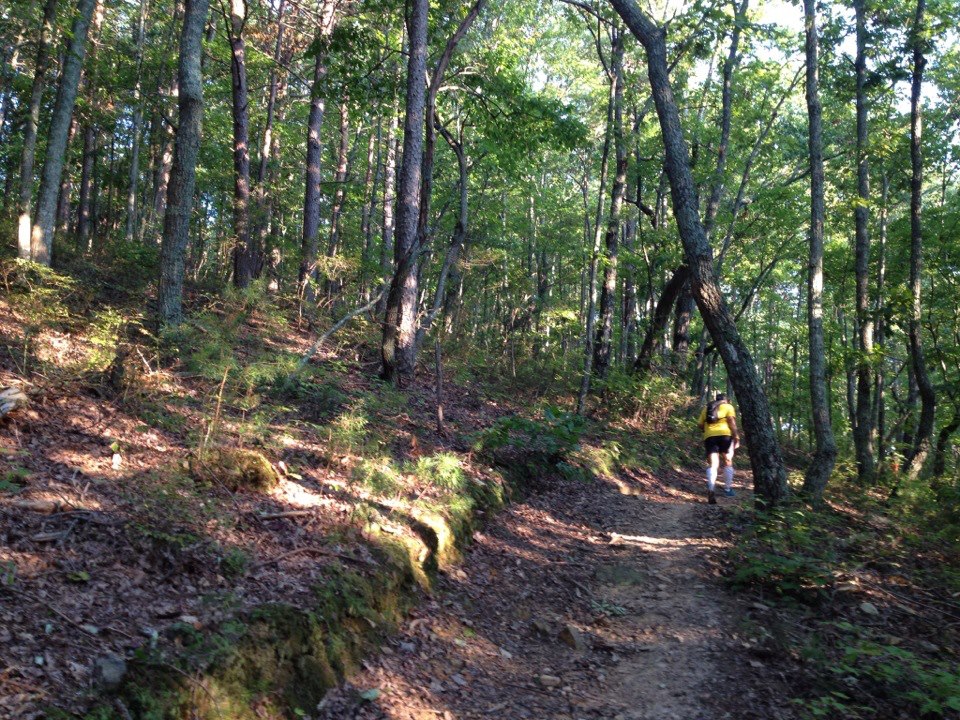
I was running happily and still feeling energetic on the trails along Sweetwater Creek just past the halfway point of the race.  I had not brought any gels and had only one handheld water bottle, but I had only taken a few sips of water so far during the race.  I kept up with David as he increased his pace, even during a steep climb that I had normally walked during past trail races in this area.  When David and another runner behind us both stopped at an aid station roughly five and half miles into the race, I continued past them and was now running alone on flat trails that occasionally took me over short water crossings. 

Photo courtesy of Dustin Shelley/Liza AuYeung
I was proud of myself for running at a fairly fast pace by my standards during such a rugged trail race, and that satisfaction carried me along through the next mile and half of flat trails and easy terrain.  I briefly greeted one runner as I passed him and then continued on alone through a trail network that was familiar to me after I had run along the same route several times during the Sweet H2O 50K.  This familiarity worked against me before long, though, because I became lost in daydreams and failed to notice the most obvious trail marking of the entire race, a log crossing covered with ribbons that indicated a sharp right turn.  Instead, I kept running to the left, as I normally would have during the Sweet H2O 50K race route.  After running up a gradual hill, I emerged onto a field where a small group of runners stood looking around.  One of them, a friend named Vince, asked me if we were on the right trail.  I shrugged and told him that I was just following the markings as I continued on.  After a few seconds, I realized that I had not noticed any markings recently, and I turned around, knowing that I had made a mistake.

One of the limitations of the low-carb version of my Paleo diet lifestyle that I have been following for months is that irritability can manifest itself out of nowhere in my personality when I am fatigued during a long run if I have not properly fueled myself with running nutrition.  I was instantly outraged at myself for accidentally going off course, and, within a couple of minutes, I had exhausted my quota of F-words for the rest of the year while I berated myself out loud for my mistake.  I had been so proud of my fast progress over the past mile and half, but I had now cost myself some ground by going roughly a quarter mile off course and having to run that quarter mile back to where I should have followed the markings.  I was immediately ashamed of my loss of temper, and I apologized to Vince as he ran behind me and tried to cheer me up.  I mourned that I had been doing so well before I had turned the wrong way, and Vince assured me that I was still running well.  When we returned to the correct path, I saw David and a few other runners whom I had passed earlier in the race ahead of me in the distance and was dismayed that I had lost an edge.  I was also disappointed in my behavior, because I had allowed my mistake to destroy my mental game during this race.  When one loses his temper, even briefly, he is telling the world that he is unable to control himself.  I had brought my weight under control this year, but, as I ran a flat trail straightaway through a meadow to catch up with other runners, I realized that I have a few other shortcomings that need attention.  I rubbed some dirt on the whole issue, then caught up with David and the others as we all slowed to a power-walk up a steep gravel hill to the final mile and half of the course. 

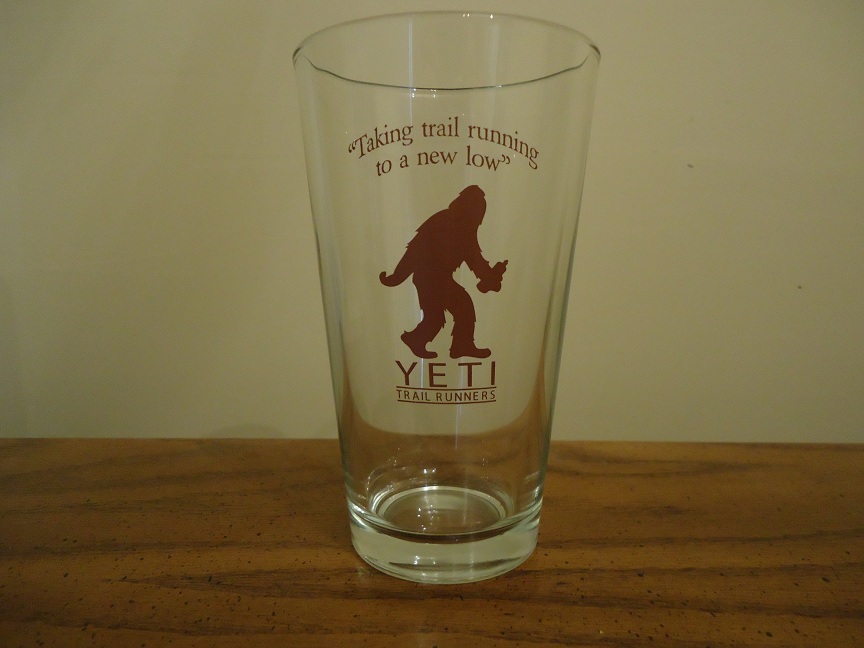
My recent mishap had fatigued me in full force, and I regretted not stopping at the aid station for a drink of Gatorade for some quick fuel.  I was happy to have only a short distance left to go, though, and I soon ran just ahead of the others to follow a runner for a half mile along a pleasant rolling-hill gravel road section.  Unfortunately, I found out that I still had one more F-word in supply when I followed the runner back onto single-track trail, immediately tripped over a tree root, and took a hard fall on the dirt and small rocks.  The kind runner stopped briefly to make sure that I was okay, and I laughed at myself as I assured him that the fall had only startled me.  With my florescent orange race shirt now slightly marred with dirt, I soldiered on and continued running along the rocky single track with new attention placed on my footing.  I suppose that, by falling on my face on a trail, I had taken the Yeti Trail Runners motto, “Taking trail running to a new low”, to heart.  My left Achilles, which was still recovering after a series of aggravations since the muddy Camp Croft Trail Marathon this past July, felt weak at this point in the race due to the steep climbs along the route, so I was thankful that I was almost finished.

Photo courtesy of Dustin Shelley/Liza AuYeung
David and two other runners passed me as we ran the final half mile to where the trail would come out of the woods to the finish.  After running faster than my comfort zone for most of the race along brutally technical trails, though, I was wiped out.  I slowed to a fast walk up the final trail hill, although I knew that I was so close, but quickly started running again when I saw someone taking photos from the other side of the hill.  I turned off the trail onto the paved road back to the finish and passed one runner as we made our way up the gradual hill turn and through the finish line. 

I had finished the Yeti Trail Race in 1:47:31 and placed 35 out of 63 finishers.  A brief what-could-have-been regret passed over me when I realized that I could have finished minutes faster and placed much higher if I had not made a wrong turn and gone off course, but that was quickly replaced by smiles as I congratulated friends at the finish and shared stories.  Several other runners had made the same wrong turn, and several other runners had tripped and fallen on the same spot of the trail where I had taken my tumble. 

In retrospect, I am pleased with my overall performance at the Yeti Trail Race.  I ran a sub-11-minute overall pace on a harshly demanding hilly trail course with my short extra distance included, and I easily climbed several steep hills that had exhausted me during past races on these same trails.  I had let myself take the race too seriously, and I had become competitive to the point of irritation when I had promised myself all along that I was only going to treat this race as a training run, but even this has a bright side when I realize that I am now racing these events and trying to challenge myself to pass faster runners whether I originally intend to do so or not.  I have always prided myself on being “too slow to ignore trail markings and get lost on a course”, but I was definitely not too slow to miss a trail marking this time around.  When I run the Georgia Jewel 50 Mile this next weekend and find myself alone for long stretches in deep forest, I need to remind myself of my error at this race and pay close attention to the trail markings. 

The Yeti Trail Race, with its challenging variety of terrain and its beautiful scenery, is my favorite shorter-distance race that I have run to date.  Even with my mistakes and shortcomings along the way, I loved every minute of this event.  Thanks to Jason Green, Kirsten Jones, David Milner, and the rest of the Yeti Trail Runners who organized this inaugural race that I hope to run every year from now on, now that I know the correct route.

See you on the trails.

Jason